Consciousness Structure (CST)
A Nested-Boundary Model of Psychological Configuration
Project: Return to Consciousness
Author: Bruno Tonetto
Authorship Note: Co-authored with AI as a disciplined thinking instrument — not a replacement for judgment. Prioritizes epistemic integrity and truth-seeking as a moral responsibility.
Finalized: July 2026
Revised: September 2026
25 pages · ~54 min read · PDF
Abstract
Psychological and contemplative configurations — the neuroses, the depressions, psychopathy, psychosis, dissociative identity, awakening — occupy a single structured space. This essay maps it. Under analytic idealism, an individual mind is a dissociated alter of mind-at-large, and the alter’s boundary admits a formal description as a Markov blanket; the architectural claim developed here is that this description nests: the dissociative boundary constituting the alter, the egoic boundary within it, and complexes as sub-blankets within that. Permeability is then boundary-relative — the ego’s openness to the alter’s own dissociated content and its openness to trans-alter content are distinct, dissociable parameters whose serial composition explains cases a single axis cannot: melancholia, sealed to the world yet invaded from within; primary psychopathy, silent behind a wall nothing constituted presses against; the mystic and the psychotic, identical in openness and opposite in everything else. Integrative coherence — a vector of stabilization, discernment, and compassion — supplies the second dimension, with regulation derived as coherence exercised at a boundary rather than smuggled as a third. A dynamics of transitions yields a structural theory of prognosis; the psychoanalytic structural spectrum enters as the typical developmental trajectory rather than a rival taxonomy; autism is situated as a calibration of the inferential channel rather than a position in the space; psychedelic risk profiles are derived from a single principle — the pharmacology moves only the fast variable. The far end of the boundary axis is mapped through biological death to its single limit point, with the epistemology that limit imposes. The model is a conceptual heuristic; its predictions are stated so that it can fail.
Keywords: dissociation · Markov blanket · psychopathology · analytic idealism · permeability · coherence · psychedelics · contemplative development · prognosis · autism
What This Essay Does and Does Not Establish
This essay establishes:
- That the clinical-contemplative space it maps is defined over the full two-boundary system — the egoic boundary (b), its permeabilities, and the varying permeability of the dissociative boundary (a) — presupposing only that (a) remains present, not dissolved: the scope discipline that SCI’s two-boundary distinction imposes
- That permeability is boundary-relative: πint (ego ↔ the alter’s own dissociated content) and πfield (ego ↔ trans-alter content) are distinct, dissociable, and serially composed — and that any single permeability axis degenerates precisely on melancholia, psychopathy, and the mystic/psychotic contrast
- That regulation is not a third primitive but coherence exercised at a boundary, and that coherence is a vector whose components (stabilization, discernment, compassion) fail selectively
- That the psychoanalytic structural spectrum is a trajectory through this space — the typical developmental diagonal — rather than a rival taxonomy; and that Bergeret’s structural fixity is the clinical appearance of steep cost gradients, not of forbidden regions
- That the origin-history of dissociated content (repressed, fragmented, never-symbolized) is the dominant variable in transition cost, generating a structural theory of prognosis
- That autism marks a third parameter class — precision calibration of the inferential channel — outside the state-space the model describes, while autistic states fall inside it
- That psychedelic risk profiles follow from a single principle: the pharmacology moves only the fast variable
This essay does NOT establish:
- Any validated clinical instrument or treatment protocol. The model is a conceptual heuristic; its clinical claims are predictions, not results
- That coherence has incremental validity over established constructs (affect tolerance, decentering, mentalization). That is the model’s principal empirical debt, named in Section III and in the failure conditions
- Anything about the ontological status of entheogenic “teaching.” Section VIII states a minimal and a strong reading and leaves their difference where SCI leaves interiority: third-person undecidable
- That the dissolution of the dissociative boundary is observable. Section IX argues it is epistemically closed from both sides — a postulate that asymptotic sampling constrains but cannot confirm
Introduction
Contemporary psychiatry has accumulated correlates — neurotransmitter imbalances, structural brain differences, genetic risk factors — while explanations of why people suffer and how they heal remain contested. Its dominant diagnostic systems group patients by symptom clusters that collect heterogeneous mechanisms, treatment responses, and prognoses under single labels. And its maps stop where its ontology stops: no clinical chart has a coordinate for the states the contemplative traditions describe as the endpoint of human development, because within materialist constraints there is nowhere to put them.
This essay develops a dimensional alternative from a different ontological starting point. Under analytic idealism — assumed here, argued elsewhere in this project (RTC) — an individual mind is a dissociated alter of mind-at-large: a bounded perspective within one experiential field. Dissociation is the single mechanism by which consciousness partitions itself, operating at every scale: the field dissociates into individual minds, individual minds dissociate further into semi-autonomous complexes, and when internal dissociation intensifies, the result is dissociative identity. The differences are of degree — boundary strength and permeability — not of kind. Psychological configuration then becomes a matter of structure: which boundaries exist, how open each is, and what the interior can metabolize. Two variables organize the space. Permeability governs what crosses a boundary and can shift in minutes; coherence governs what the interior can integrate and builds over years. Their dissociability under stress is what generates clinical risk — and, this essay argues, most of the structure of psychopathology and contemplative development besides.
Five disciplines govern the construction. Coherence must be operationalized prospectively, or the model’s central predictions are unfalsifiable by construction (Section III). Permeability must be stated relative to a specific boundary, because the clinic contains cases — melancholia first among them — that are sealed and flooded at once (Section II). The distinction between regulated openness and unregulated rupture must be derived from the model’s own variables, not carried by an adjective that belongs to neither axis (Section III). The model must say what moves a person between configurations, which is where clinicians actually live (Section VI). And in a framework whose ontology is maximally relational, the variables cannot all be monadic properties of an individual: the relational term — coherence borrowed and content evacuated across boundaries — is made explicit throughout (Sections V, VI, VIII).
A clinician need not accept the ontology to use the structure. The configuration space, the prognostic taxonomy, and the predictions of Sections X–XI stand as phenomenological and clinical claims; idealism supplies the interpretive layer that explains why the structure coheres and where its far end lies. Description, throughout, is not recommendation: nothing in this essay is clinical guidance.
I. The Architecture: Nested Blankets
Under analytic idealism, an individual mind is a dissociated alter of mind-at-large, and the alter’s boundary admits a formal description that the tradition itself supplies: Kastrup models it as a Markov blanket — a statistical boundary across which internal states track external ones without direct coupling. SCI examines whether that description can be promoted to a criterion of interiority; this essay needs something weaker and safer. It needs only the descriptive use, with the direction of description that idealism fixes: the boundary is ontologically prior — a dissociative structure in the experiential field — and the blanket formalism is its extrinsic face, exactly as matter is the extrinsic appearance of mental process. Nothing here reads interiority off a diagram; the formalism supplies structure and halts at experience, which is SCI’s repeated finding and this essay’s inherited discipline.
One feature of the direction of description should be made explicit, because the blanket vocabulary conceals it. A Markov blanket is symmetric — conditional independence screens both ways — but the dissociative boundary is not. It is real from inside, as the limit of what the alter can access, and it does not exist from the field’s side, because the field is not outside the alter but wholly present in it (MFI). The blanket is therefore the boundary’s inside view, the only view there is. This fixes how the permeabilities below should be read. πfield is not a valve through which the field enters; the field is already there. It is the degree to which the ego has access to — and, at the coherence-dependent limit, recognizes — what was never absent. That is why the mystic and the psychotic can be identical in openness and opposite in everything else (Section III): the same traffic arrives, and one recognizes it as what was always present while the other is flooded by content it cannot label as its own.
The architectural claim — this essay’s step, not Kastrup’s, whose blanket describes only the alter’s outer boundary — is that the description nests (Figure 1):
- The alter blanket — boundary (a). The dissociative boundary constituting the alter as a private perspective within the field. Present in every case this essay’s clinical space describes.
- The ego blanket — boundary (b). A second blanket nested within the first: the executive-integrative structure that identifies as “I” and maintains itself by inclusion and exclusion. The egoic contraction — ahaṃkāra — is this blanket’s operation; the ego-structure is its extent.
- Complexes as sub-blankets. Meso-level dissociative structures — Jungian complexes, trauma networks, the melancholic’s internalized object — are further blankets nested inside the alter, outside or alongside the ego: organized, semi-autonomous, capable of their own inputs and outputs. Dissociative identity is the limit case in which sub-blankets acquire quasi-alter autonomy — each with local coherence, separated by amnesic barriers.
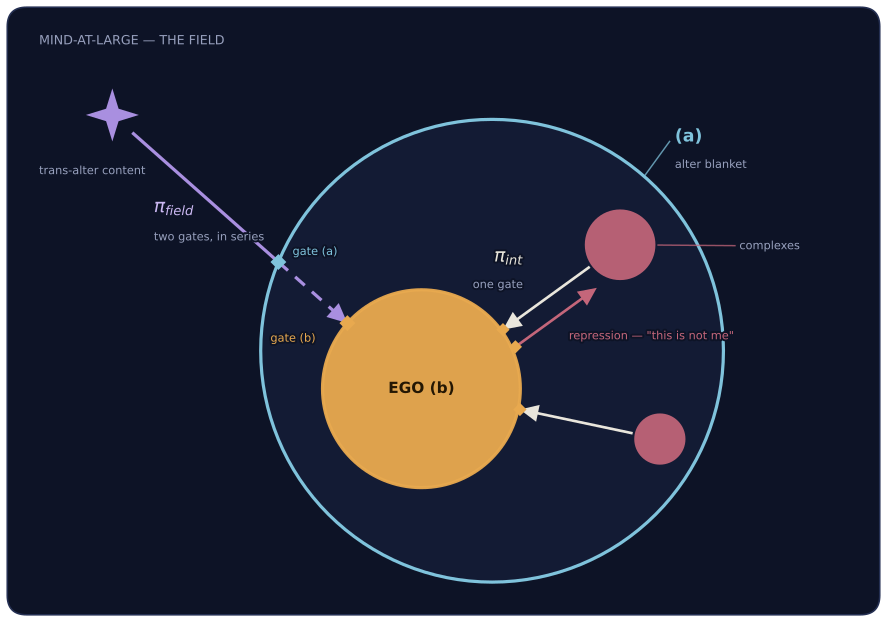
Figure 1 · The nested architecture. The alter is a region of the field, bounded by (a); the ego is a second blanket nested within, bounded by (b); complexes are sub-blankets inside the alter, outside the ego — the region where shadow material, trauma networks, and the internalized object live. The rose outbound arrow is repression: one gate-operation of (b), expelling content (“this is not me”) that feeds this region. πint: intra-alter traffic — dissociated content reaching the ego crosses one boundary. πfield: trans-alter traffic — content of the field crosses two gates in series, (a) then (b), which is why opening (a) alone never determines what is experienced.
The scope of the essay follows directly from the two outer boundaries. SCI distinguishes the dissociative boundary (a) — what makes an alter an alter, what constitutes a private interior at all — from the egoic contraction (b) — a further boundary layered within an already-formed interior. The clinical-contemplative space mapped in Sections II–VIII is defined over both: the state of (b) and its permeabilities supply the primary coordinates, while the varying permeability of (a) enters as an active variable through the serial composition of the two gates — and much of the space’s characteristic content, from the shadow to the internalized object, lives inside (a) yet outside (b). What the space presupposes of (a) is only that it is present — not dissolved. Section IX extends the same axis past the clinical range — through the reconfiguration at biological death to its single genuine limit point — and states the epistemology that limit imposes.
Two notes before proceeding. First, terminology: “dissociation” operates at two scales in this project — the ontological (boundary (a): the one field dissociating into alters, Kastrup’s usage) and the clinical (sub-blankets within an alter). This is not equivocation but the same operation at different levels of the nesting; the reader should track which level a given sentence inhabits. Second, lineage: modeling complexes as sub-blankets is not a liberty taken with Jung but fidelity to him. His complex theory descends from Janet’s dissociationism, not from Freud’s repression — complexes are “splinter psyches,” partial personalities with autonomy enough to personify in dreams and, in psychosis, to speak (Jung, CW 8) — while repression remains one route among several by which a complex is fed with content, and the archetypal core of a complex was never egoic at all, hence never repressed. The distinction matters downstream: dissociation names the structure; repression names one gate-operation — a distinction Section VI’s origin-history taxonomy depends on.
This architecture has a precursor, and a project that diagnoses appropriation with lineage erasure (Section V) is obliged to name its own. The division of credit should be exact. Kastrup supplies the ontology and the outer blanket; the ego appears in his account as a functional distinction within the alter — narrowed self-identification, metacognitive re-representation — not as a second boundary, and the nesting is not his. The vocabulary of complexes, shadow, and archetypes-as-attractors is Jung’s, and so is the structure: an ego that is the center of consciousness only, nested within a Self that is the totality of the psyche, with autonomous complexes populating the space between them. The ego-Self axis, as the post-Jungians named it (Neumann; Edinger), is the relation between blankets (b) and (a), described eighty years early and without the formalism. Jung also supplies the compensatory function this essay invokes in Section VIII, and — as noted below — the correct name for one of its failure modes.
The nesting does two things for Jung in return. It disambiguates a notorious equivocation: Jung’s Self slides between the totality of the individual psyche and something transpersonal reaching beyond it. Two boundaries separate the readings cleanly — the Self-as-totality is the alter, bounded by (a); the Self-as-transpersonal is the field showing through an (a) that is permeable. Both were true; they were never the same object. And analytic idealism relieves Jung of his worst embarrassment: the collective unconscious needs no inheritance mechanism, no Lamarckian transmission of archetypes through brains. It is simply what lies on the far side of (a) — shared not because it was passed down but because it was never divided. Jung reached for this himself, in the psychoid and in the unus mundus, without an ontology that permitted it.
The cost is stated plainly, since Section III’s discipline applies to allies as much as rivals: Jung is harder to operationalize than Klein, his individuation carries a teleology this essay’s non-causal stance does not adopt, and importing him raises rather than lowers the circularity risk that Prediction P3 guards against. He is used here for structure, not for evidence.
Three consequences follow immediately. First, permeability becomes a relation between blankets, not a global property of the person — the split that Section II develops. Second, “dissociation at every scale” stops being a verbal gesture and becomes one formal architecture, from the field down to the complex. Third, each boundary has directionality built in for free: the active-inference formalism distinguishes sensory from active states, so inbound and outbound permeability can differ at the same boundary — an asymmetry that turns out to carry clinical weight.
II. Two Permeabilities
Define, within an alter whose boundary (a) is present:
- πint — the permeability of the ego blanket to the alter’s own dissociated content: shadow, complexes, traumatic memory, the internalized object. One boundary crossed.
- πfield — the effective permeability of the ego to trans-alter content: transpersonal, archetypal, other minds. Two boundaries crossed in series, so πfield is a composition: no primitive of its own, but a function of the state of (a) and of the ego blanket’s outward face. Opening (a) alone determines nothing phenomenologically; everything depends on what the egoic boundary does with the traffic that arrives from it.
A note on the symbol, since a referee would ask what kind of quantity π is. Throughout this essay π is used as an ordinal parameter — low, moderate, high, with qualifiers for regulation and direction — sufficient for every claim that follows. Its natural formalization, given the architecture, is nonetheless worth registering: precision-weighting over the respective blanket’s states — the gain assigned to messages crossing that boundary. That identification is what makes the essay’s finer machinery available for free: directionality, because a blanket’s sensory and active states carry independent precisions, so inbound and outbound permeability dissociate natively; and serial composition, because a two-gate channel cannot be more permeable than its most closed gate, giving πfield ≈ f(πa, πb) a candidate functional form. One disambiguation then becomes obligatory: the precision at stake here is dissociative-boundary precision — the gain on inter-blanket traffic — not the perceptual precision of Section VII, which is the gain on sensory prediction error within the inferential hierarchy. Both are precisions; they operate at different boundaries, which is why autism is a calibration and not a configuration. Nothing below depends on the formal identification; everything below is stated so that it could survive one.
The split has a century-old precedent that deserves naming: it is Jung’s distinction between the personal unconscious — complexes, the repressed, the shadow: intra-alter content, one boundary from the ego — and the collective unconscious — archetypal content, two boundaries away. The two permeabilities are the two unconsciouses restated topologically, and the architecture explains rather than merely inherits the distinction: it falls out of the nesting.
A single permeability axis is the coarse-graining of these two — legitimate wherever they covary, degenerate wherever they dissociate. The degenerate cases are not exotic; they are among the most common and the most consequential:
Melancholia. Freud’s melancholic is sealed to the world and vitality — low πfield — while being bombarded from within by a hostile internalized object: “the shadow of the object fell upon the ego.” That is high, involuntary, inbound πint: rumination, intrusive guilt, self-attack — with the outbound direction blocked. A single scalar cannot say “closed and invaded at once.” Two boundary-relative parameters say it in four coordinates. The clinical payoff is a subtype distinction the categorical label erases — sealed depression (both permeabilities low; emptiness, anhedonia) versus invaded depression (field low, internal channel ruptured one-way) — with opposite implications for any intervention that opens boundaries (Section VIII).
Primary psychopathy. An apparent anomaly — high stability with absent compassion, which a scalar notion of coherence cannot represent — dissolves under the split. The psychopathic configuration is not high coherence with a missing component; it is πint near zero by foreclosure: affective content that was never symbolized in the first place, so that nothing constituted exists on the far side of the boundary to press against it. The calm is not a container’s capacity; it is the silence of a wall no visitor has ever reached. Section IV gives this its full treatment against its nearest neighbor.
The mystic and the psychotic. Both have the serial channel open; they differ in everything else. The mystic opens both gates in a regulated way onto an interior with nothing left dissociated; the psychotic has both gates ruptured at once, so archetypal material arrives interleaved with personal traumatic material at an ego already in fragments — which is why delusion characteristically braids the cosmic with the biographical. A single axis places these at the same coordinate and needs an external adjective to separate them. The composition, plus Section III’s derivation of that adjective, separates them structurally.
III. Coherence, Disciplined
Coherence is the interior’s metabolic capacity: what it can host, hold in contradiction, and integrate without fragmenting. Three disciplines keep the construct honest.
Against circularity
If coherence is known only by its outcomes, every outcome confirms the model — whoever integrated must have had it. The repair is prospective operationalization through measures that exist independently of any given episode — affect tolerance, decentering, reappraisal flexibility, mentalization — and the honest statement of the debt this incurs: those constructs are already validated, so the model owes incremental validity. Either a coherence battery predicts integration outcomes beyond its components, or “coherence” is an elegant redescription and should be retired as a scientific term while remaining a useful clinical shorthand. Prediction P3 and the failure conditions hold this essay to that.
Coherence is a vector
Three components, contemplatively ancient and factor-analytically separable: stabilization (the capacity to remain present with content — śamatha-like), discernment (the capacity to see content’s structure without capture — vipaśyanā-like), and compassion (the capacity to relate to content, one’s own and others’, without attack or abandonment — karuṇā-like). They develop separately, fail separately, and their profile matters: high discernment with low compassion yields the cold analyst of one’s own psyche; high stabilization with low discernment yields the calm that never understands itself. Kleinian reparation — the affective, not merely cognitive, exit from splitting — is the classical description of the compassion component doing integrative work; Jung’s transcendent function — holding opposites in tension until a third position emerges — is the classical description of hosting contradiction without premature resolution.
Regulation, derived
The load-bearing distinction between “regulated” openness and “unregulated” rupture does third-axis work unless it is derived from the two variables already on the table. The derivation: regulation is coherence exercised at a boundary — the vector’s components applied to gating itself. Stabilization at the boundary is the capacity to keep a gate open under load without it tearing; discernment at the boundary is selectivity about what crosses and when; compassion at the boundary is hospitality without either merger or expulsion. The derivation carries a test: high coherence with high, chronically unregulated permeability should be impossible by definition, not merely rare — if a counterexample is found, regulation is a genuine third primitive and the model’s dimensionality claim fails (see the failure conditions).
Frozen coherence
The pathology of the coherence axis itself: a framework so successful that it stops metabolizing and starts absorbing — every new content incorporated as further confirmation, rigidity presenting as integration. The configuration is ontologically neutral, and stating this matters: the advanced practitioner whose realization incorporates every challenge as spiritual test and the hard-nosed materialist whose framework reclassifies every anomaly as pathology or noise are the same topology with different contents. Each runs an incorporation rule that pre-processes disconfirmation — “resistance” in the one vocabulary, “malfunction” in the other — and declaring in advance that a change of one’s own belief would certify one’s own impairment is that rule announced as policy. Its structural marker is brittleness: revisability under pressure distinguishes living coherence from crystallized coherence, and the pressure must come from outside the interpretive loop, since the loop metabolizes internal challenges by design. This configuration returns in Section VIII as the subtlest entry in the risk profile — the only one whose danger is marked by the absence of crisis.
IV. The Configuration Atlas
Nine configurations, each specified in the fine coordinates. Nothing in this atlas is a separate disease; the claim of the model is dimensional — the same space, differently configured.
| # | Configuration | Coordinates | Structural signature |
|---|---|---|---|
| 1 | Ordinary ego | πint low–moderate · πfield low · (a) sealed | Small ego; split-off content constituted but excluded, traffic mostly blocked by the operation “this is not me.” Functional, structurally incomplete. |
| 2 | Sealed depression | πint low · πfield low · ego-dystonic | Thickened wall, dimmed interior (anhedonia). Once-symbolized content presses against the seal; the dull ache is that registered pressure — the seal is suffered. |
| 3 | Invaded depression | πint high, one-way inward · πfield low | A hostile sub-blanket — the internalized object — bombards the ego one-way; rumination loops inside; outbound is blocked. Freud’s shadow of the object. |
| 4 | Primary psychopathy | πint ≈ 0 (foreclosure) · πfield low · ego-syntonic | Never-symbolized content has nothing constituted to press. Silence, not capacity. One live exteroceptive corridor — sensation-seeking as substitute traffic. |
| 5 | Acute psychosis | πint and πfield ruptured, in series | Archetypal material enters through breaches of (a) and reaches an ego in fragments, braided with personal traumatic content — why delusion interweaves the cosmic and the biographical. |
| 6 | Dissociative identity | partitioned coherence · (a) sealed | Not one ego but several — each sub-blanket with local coherence and its own memory, behind amnesic barriers. Survival at the cost of unified experience. |
| 7 | Awakened | πint integrated · πfield high, regulated | The ego boundary expanded to near-coincidence with (a); integration has emptied the intra-alter outside. Both boundaries regulated-permeable; traffic two-way and voluntary. Individuation persists. |
| 8 | Transient opening | π ≈ total, temporary · samādhi / 5-MeO class | (a) near-fully open, the ego temporarily dissolved. Whoever comes back and reports proves, by the report, that (a) persisted. |
| 9 | Frozen coherence | sealed · rigid interior · brittle | A crystal-lattice interior: absorbs, no longer metabolizes — every content incorporated as confirmation. No crisis, no symptom; the marker is brittleness under pressure from outside the loop. |
The hard pair: psychopathy × sealed depression
The two configurations are near-neighbors in the coarse coordinates — both permeabilities low — which is itself a result: it explains the phenomenological overlap the clinic knows well (chronic emptiness, boredom, affective flatness). The fine parameters separate them:
| Sealed depression | Primary psychopathy | |
|---|---|---|
| Nature of the seal | Content symbolized, then split off (repression): it exists on the far side and presses. The suffering itself is evidence of a residual leak — some πint registers the loss. | Content never symbolized (foreclosure, in Lacan’s sense): nothing constituted exists to press. The silence is complete. |
| Syntony | Ego-dystonic — the seal is suffered. | Ego-syntonic — no registered lack. |
| Behavioral signature | Seal with registered lack → hypoactivity, withdrawal. | Seal without registration → sensation-seeking: generating traffic through the only live channel, the exteroceptive corridor — the ordinary sensorimotor channel between ego and world, not a special structure but the common channel everyone has. |
| Under boundary-opening interventions | The original indication (Section VIII). | Near-null expected benefit: nothing constituted to integrate (Sections VI, VIII). |
One consequence of the foreclosed configuration deserves explicit statement, because it derives as a single package findings usually listed separately. If the corridor is the only live channel, pain is the loudest signal available in it — one’s own or another’s — and the chronic physiological hypoarousal of primary psychopathy (the classic stimulation-seeking account) makes maximal signals the only ones that register at normal volume. Indifference to harm then requires no second mechanism: suffering — one’s own future suffering, another’s present suffering — simply never constitutes itself as suffering behind a silent boundary; it registers as intensity, or as information. The same architecture derives the well-replicated empathy dissociation: modeling another’s states is a boundary competence and remains intact — hence the manipulative precision — while resonating with them is cross-blanket traffic, and is absent. Another’s pain is perfectly legible and entirely non-resonant, which is precisely the condition under which cruelty becomes available as an instrument. Prediction P8 gives this a discriminating behavioral marker.
One clarification, because the vector invites a misreading. “Silence, not capacity” names which coordinate distinguishes the configuration — the calm is not stabilization, and global low coherence with open boundaries is the psychotic coordinate, not this one — it does not certify the coherence profile intact. The compassion component is near-null, and under this ontology that is a coherence fact in the strict sense: if individual minds are dissociative partitions of one interdependent field, then relating to content — one’s own or another’s — without attack or abandonment is not a moral ornament on the vector but the affective registration of how things stand, and its absence is a failure of the interior to track the field it belongs to. The absence, however, is derived, not primitive. Compassion is exercised on constituted content, and resonance is cross-blanket traffic; behind a foreclosed boundary the capacity has nothing to develop against. The deficit is real and measurable (P1) — but not remediable in place, because its precondition is missing upstream: the route, if any, is constitution, not integration (Section VI). What distinguishes the configuration is the boundary fact; the null compassion component is how that fact registers on the coherence axis.
The expansion paradox, resolved
Contemplative language says “reduce the ego”; the atlas shows the awakened ego larger — nearly coextensive with the alter. The paradox dissolves once “ego” is split into what the topology splits: the ego-structure (the integrative-executive extent of blanket (b)) grows in reach, while the ego-contraction (ahaṃkāra, the exclusion operation “this is not me”) thins. They are coupled: the structure can extend only as fast as the contraction relaxes, because the exclusion operation is what held the content outside. “Ego death” is topologically misleading — what dies is not the perimeter but the operation that made the perimeter a wall. This is Jung’s individuation restated as topology — the ego-Self axis of Section I, set in motion. Jung’s lifelong insistence that individuation strengthens rather than dissolves the ego — against the orientalizing readings of his era — is exactly the structure/contraction distinction: the ego is relativized to the Self, not abolished; decentered from sole occupancy and set in relation to a totality that exceeds it. Jung also named the failure mode, and named it in 1928: inflation — the ego identifying with the Self or with archetypal content instead of relating to it, the perimeter mistaking itself for the whole. It acquires a precise definition here: a claimed coincidence of (b) with (a) in advance of the integration that would make it real — the crystallizing rule of Section III and the incorporating exit of Section VIII, diagnosed a century early. At the limit, blanket (b) becomes coextensive with blanket (a) and ceases to be a distinct boundary: functionally one blanket remains. That is the structural face of non-dual phenomenology — no experienced inner partition, and a perspective that remains individuated, since (a) still stands: the sage still cannot feel your pain (ETH).
Provenance: the boundary as labeler
The egoic boundary does not only gate traffic; it tags provenance. Every content that reaches the ego arrives labeled — my thought, my memory, perception of the world, dream — and reality-testing is this labeling function, not a separate faculty. Psychosis is then a double failure: permeability ruptured (too much traffic) and labeling failed (intra-psychic content arriving tagged as outer perception). Lacan’s formula — what is foreclosed from the symbolic returns in the real — and Jung’s early observation that the voices of psychosis are personified complexes describe the same event: a sub-blanket’s content crossing with the wrong provenance tag. Literalization is mislabeled crossing. The dream is the benign control case — labeling suspended in-state and reapplied retroactively on waking (“it was a dream”); the psychotic has lost the retroactive relabel. At the other end of the axis, the awakened configuration is labeling completed: thoughts tagged as thoughts, emotions as emotions, and at the limit the self-model itself tagged as content. The māyā-vision of the traditions is not an exception to this but its completion, read through the two truths (Nāgārjuna): conventional labels remain fully operational — the sage does not step in front of the bus — while a meta-label is added over the whole system, all of this, inner and outer, is appearance in consciousness; which, under this project’s ontology, is simply accurate, since the label “external world” always was the label for trans-alter content mediated by (a). Literalization and māyā-vision are exact inverses: one takes content for thing; the other recognizes even things as content, without losing the functional discrimination. And the clinical mimic completes the pattern as a fourth hard pair: derealization presents the same propositional content — “everything seems unreal” — as involuntary label-failure, with suffering, lost vividness, impaired function; the awakened configuration presents it as voluntary meta-labeling, with heightened vividness, intact function, equanimity. Same sentence, opposite configurations — the model’s recurring lesson that surface reports underdetermine structure.
V. Trajectories: The Psychoanalytic Spectrum as a Special Case
The French structural tradition — Bergeret’s spectrum, taught in the psycho-organic lineage through charts of the Mathé type, resting on Klein’s positions and Spitz’s first year — organizes pathology as a developmental continuum: autistic origin, psychotic structure, borderline arrangement, neurotic structure, well-being, with a striking non-clinical coda (“enaction, spirituality; suspension of beliefs”) that most clinical maps lack. The claim of this section: that continuum is not a rival taxonomy but a trajectory through this space — the diagonal most human development actually traverses — and reading it as a trajectory dissolves its two standing anomalies while inheriting its real content.
Plot boundary openness against coherence and the trajectory draws itself. Development begins at infant openness-without-coherence — near the psychotic region’s coordinates, which is the point: infant openness is unregulated. It proceeds through the partial seal of ordinary adulthood, and — where it continues at all — reopens contemplatively with coherence, arriving at an openness matching the psychotic’s with the opposite metabolic capacity. The French chart’s own loop-arrow (“return to the autistic pole on a non-psychotic structure”) is this hook drawn natively by two axes. Against it stands the shortcut: opening without the slow variable, which lands at the same openness as the mystic with collapsed coherence. The model forbids the shortcut as development and explains it as collapse — and predicts that population density concentrates along the hook, with off-diagonal occupancy (frozen coherence, psychopathy, mania — a permeability spike outrunning coherence in real time) rare and specifiable (Prediction P5).
What the trajectory reading inherits and repairs:
- Klein’s positions become native citizens. Read as configurations rather than stages — as Klein herself insisted and Ogden systematized — the paranoid-schizoid and depressive positions are regions of this plane between which adults oscillate lifelong (Bion’s PS↔D). The depressive position is a coherence achievement: holding that the good and bad object are one object — hosting contradiction without splitting — with reparation as the compassion component doing the work. This is the strongest psychoanalytic ally against structural fixity.
- The anxiety typology maps onto coordinates. Annihilation/engulfment/fragmentation anxiety = rupture of boundaries with collapsed coherence (the psychotic region). Abandonment/separation anxiety = an unstable boundary with partial coherence, conflict enacted because it cannot yet be hosted (the borderline region). Castration anxiety = a moderately sealed boundary with sufficient coherence (the neurotic region) — the ordinary ego’s signature threat, loss within an established triangulation.
- Bergeret’s fixity becomes a cost statement. The tradition holds structures fixed for life; this model holds the space navigable. Section VI reconciles: no forbidden regions, but cost gradients steep enough that, with ordinary resources, most lives never cross them — fixity as the clinical appearance of a gradient, empirically near-right and theoretically wrong. The ceiling Freud stated with characteristic honesty — transforming hysterical misery into common unhappiness — was not clinical pessimism but an ontology’s ceiling showing through its best practitioner.
- Projective identification becomes literal traffic. The Kleinian mechanism — evacuating dissociated content into another, who comes to feel it — strains materialist explanation (microsignals, “unconscious communication”) and reads almost literally here: outbound traffic crossing the ego blanket, the alter blanket, and entering another’s nested system, across boundaries that idealism holds to be graded partitions of one field. This is the first appearance of the relational term the model owes; Section VI’s “borrowed coherence” is its constructive twin — Bion’s container is inbound scaffolding, projective identification outbound evacuation, two directions of the same cross-blanket channel.
- The perversion band acquires coordinates — and splits into three topologies. The chart places perversion in the borderline region (dyadic register, abandonment anxiety), and the architecture says why, while distinguishing what surface behavior confuses. Masochistic suffering is object-directed: pain as the currency of an endangered tie — better beaten than abandoned — and saturated with the guilt the foreclosed configuration cannot have. It is non-substitutable by non-relational intensity, because the target is the object, not the volume. Borderline self-injury is boundary reassertion: intense somatic input marking the perimeter of a dissolving self — presupposing a suffering interior, the structural opposite of foreclosure. The corridor’s sensation-seeking, by contrast, is stimulus-general: any loud signal serves. Sadism proper correlates with psychopathy yet factors separately (the dark-tetrad finding), fusing with structure only in malignant narcissism — aggression integrated into grandiosity, identity organized around triumph over the object. Consensual BDSM belongs to none of these: negotiated scenes with explicit limits are joint, voluntary boundary-regulation, and its practitioners profile as psychologically unremarkable.
- One foundation is removed rather than inherited. The chart anchors its origin in Mahlerian “normal primary autism” — a pre-relational first stage that infancy research has not sustained: infants are intersubjective from birth. Section VII gives autism the treatment the tradition’s error makes necessary.
VI. Dynamics and Prognosis
A map of positions without a theory of motion answers no clinician’s actual question. The dynamics follow from four principles, none imported: each is generated by machinery already on the table.
1. The asymmetry of time constants
Permeability changes in minutes (a molecule, a trauma, a breath practice); coherence changes in months to years (it is capacity, built by metabolizing). Nearly everything follows from this one asymmetry.
2. The slope principle
Transitions are not symmetric. Collapse is fast because it requires only rupture of the fast variable — decompensation, trauma, the psychotic break. Recovery and development are slow because they require construction of the slow variable. The space has a thermodynamics: descent is free fall, ascent is climbing. This derives, rather than merely records, the brute clinical fact that one falls ill in weeks and heals in years. It also states the clinical sequence — stabilization before opening — as geometry: the climb back from collapse has two phases with two clocks, containment first (closing the boundary is the fast variable — weeks), then integration (building coherence — years).
3. Cost is dominated by the origin-history of the content
What integration must do depends on what the split-off material is:
- Symbolized, then split (repression). Integration is re-access: the material exists, has form, and can be reapproached as coherence permits. Moderate cost — the territory where psychotherapy demonstrably works: the neuroses, sealed depression, symbolizable trauma. The ladder is intact.
- Symbolized but shattered (severe trauma, dissociative identity). Integration is re-assembly: slow, necessarily sequenced — stabilization before opening — but the material exists. High cost, viable. The ladder exists in stages, with platforms.
- Never symbolized (foreclosure: primary psychopathy, psychotic kernels). Integration-as-such is impossible, because there is nothing constituted to integrate; the work would first have to be constitution — primary symbolization, which is the achievement of early relational life (Roussillon’s central territory). Near-prohibitive cost within an adult lifetime: a wall, with no ladder. The model here predicts what the clinic only records: psychopathy’s notorious treatment-resistance is not resistance but the absence of an object of work.
This ordering yields a non-obvious prognostic inversion: acute psychosis carries a better intra-life prognosis than stable psychopathy — the psychosis has content (chaotic, but constituted; restore the boundary, rebuild coherence, and there is something to integrate) — which contradicts apparent severity and matches recovery data.
4. Coherence is partly borrowed
Transition cost is not a property of the individual configuration alone. Coherence can be lent: Bion’s container is originally another mind — the caregiver’s alpha-function metabolizing what the infant cannot, coherence internalized as a relation. Therapist, sangha, marriage, ritual community function as external coherence sustaining traffic the internal vector cannot yet hold, rendering payable transitions that are prohibitive in isolation. Prognosis is therefore two-place: configuration × relational field. This gives the model’s anti-categorical argument a further mechanism — identical diagnoses diverge radically by container — and it is the constructive face of the channel whose evacuative face is projective identification (Section V).
Discontinuous transitions
The space also permits jumps — conversions, spontaneous remissions, post-traumatic growth, the sudden awakenings of the traditions (kenshō). In this vocabulary: permeability peaks that meet sufficient latent coherence and reorganize the configuration at once. The model’s standing discipline applies — a peak without coherence is the recipe for the psychotic region, and insight is not integration — and it supplies the observable difference: a genuine jump consolidates into function (months later, the person metabolizes better); a pseudo-jump becomes inflation, bypass, or collapse. Zen already carries the distinction: kenshō is not stabilized satori.
The arc-scale reframe
On this project’s ontology, the unit of a mind’s development is not the biological lifespan but the dissociative arc (BSE, SAC). At arc scale, no configuration is incurable by definition; coherence gains are assets of the arc — the structural residue the traditions call saṃskāra. This is stated as what it is: the soteriological frame interpreting the clinical structure, not a prediction, and unverifiable in the third person. Its ethical consequence, however, is concrete: work with the “hopeless” case — the foreclosed, the demented, the refractory — is not futile but contributory to a trajectory whose scale the clinician does not see. The contrast that closes the circle: the French chart’s spectrum terminates at Mort; this one terminates at a limit point beyond it, with the intermediate states mapped (Section IX). The ceiling of a prognosis is the ceiling of an ontology.
VII. Calibration: Where Autism Actually Sits
The French chart placed autism at the origin of its spectrum, as the most archaic state — incorrectly, as Section V noted. A cautious dimensional model would simply exclude it, on the suspicion that non-dissociative mechanisms are at work. The nested architecture can do better than both: it situates autism without pathologizing it into the dissociative spectrum, because the blanket has more parameters than the two the configuration space plots.
The bridge is already paid for: this essay’s formalism is active inference, and autism has a mature literature in exactly that formalism. The convergent family — aberrant precision (Lawson, Rees & Friston), attenuated priors (Pellicano & Burr), HIPPEA (Van de Cruys et al.), and the intense-world account by the neural route (Markram) — says roughly: in autism, sensory precision is weighted high and attenuating priors are weak. The world arrives in high fidelity, without the top-down smoothing the typical brain applies. In this essay’s vocabulary: not a position on the permeability axis (how much crosses the boundary) but a calibration of the channel (how what crosses is weighted and filtered). Precision-weighting and permeability are distinct parameters of the same blanket. Autism is not a state of the boundary; it is a constitutional configuration of the inferential instrumentation.
This dissolves the tradition’s founding error with some elegance. Mahler placed autism at the origin by reading autistic withdrawal as objectlessness — the pre-relational state. The intense-world reading inverts it: the autistic infant is not hypo- but hyper-receptive, and withdrawal is protective regulation against sensory flooding, not regression to a worldless stage. The phenomenology of overload resembles boundary rupture — hence the chart’s confusion with the archaic pole — but the mechanism is opposite: the autistic boundary is intact, often strong; there is no loss of reality-testing, no self/non-self fusion, no psychotic literalization. The chart committed a differential-diagnosis error at the level of theory: channel calibration mistaken for boundary state.
The two-level reading that neither the chart nor a bare exclusion could state:
- The trait sits outside the configuration space — a parameter, not a position. The exclusion a cautious model would settle for is thereby upgraded to a result: the model applies to states, not to the trait, and the distinction is itself derived.
- The states sit inside it. High sensory precision means chronically elevated integrative demand — more high-fidelity traffic per unit of experience. Meltdown and shutdown are transient coherence overloads under exceptional demand — not coherence deficits (capacity may be high; demand is higher), but the same flooding mechanism the model describes for anyone, running at higher input gain. Masking is structurally a continuous coherence expenditure — simulating social priors that do not come factory-installed — and autistic burnout its cumulative cost. This is why autistic people describe these crises as qualitatively unlike psychiatric ones: they are, in the model’s terms: channel overload, not boundary rupture.
Two corollaries. The model predicts the advantages alongside the costs, which aligns it with the neurodiversity reading rather than against it: weak priors mean less smoothing (the visual-search superiorities, reduced susceptibility to certain illusions) and less capture by the consensual prior — structural, not attitudinal, independence of thought. A calibration with trade-offs, not a deficit with residues. And Milton’s double empathy problem acquires a structural formulation: the social difficulty is not a unilateral failure of one blanket but a mutual-modeling mismatch between differently calibrated blankets — each side predicting the other poorly. Relational, symmetric, testable.
The owed honesty: this is a family of hypotheses, not consensus, and autism is too heterogeneous for one theory. And there is a temptation to resist — once the architecture can speak about autism, it would be easy to slide from situating it to explaining it, repeating in new vocabulary the chart’s old error. The safe formulation for the corpus: autism demonstrates that the blanket has at least a third parameter class — precision calibration — that is neither clinical nor contemplative but constitutional; the model describes the space of boundary states, and different systems traverse that space with different instrumentation. One genuinely open question follows, stated as such: if contemplative practice works partly by relaxing rigid priors, and autistic calibration ships with priors already attenuated, the autistic contemplative path should have its own phenomenology and risk profile — less perceptual-deconstruction work, higher load on stabilization. Almost unmapped territory; Prediction P4.
VIII. Application: Psychedelic Risk, Derived
Every entry in this section derives from one principle:
Psychedelics act almost exclusively on the fast variable. They open permeability in series — (a) and (b) at once, without discrimination — in minutes, while coherence gains nothing in the act (and transiently drops, since discernment itself is perturbed). The entire risk profile is a photograph of where each configuration stands on the slow variable — and on the fine parameters the slow variable hides.
REBUS, embedded and extended
The principle has a canonical formal model. REBUS (Carhart-Harris & Friston, 2019) describes psychedelic action as relaxation of high-level priors — precision drops, suppressed content ascends — and this essay adopts it as the mechanics of the fast axis; the lineage runs deeper still, since the same authors had already translated Freudian ego-functions into free-energy terms a decade earlier. But the embedding is corrective in both directions. REBUS is a one-variable model in a space that needs two: it characterizes the opening and is silent on the metabolizing, which is why it cannot in principle distinguish the mystic from the psychotic — both have relaxed priors; they differ in coherence, which REBUS does not represent. It is likewise blind to the serial architecture: a “relaxation” that distinguishes neither boundary (a) from boundary (b) nor inbound from outbound traffic predicts uniform benefit in depression — precisely what the invaded subtype contradicts, and what P2 tests. And REBUS is a model of the acute state: its own annealing metaphor — the landscape softens and resolidifies — leaves the resolidification ungoverned. Coherence is what governs it. The same softening resettles as consolidated insight or as inflation and fragmentation depending on the slow variable — which is why frozen coherence is invisible to REBUS (priors relax and resettle identical, reinforced) and why foreclosure yields nothing to relax: there is no constituted content beneath the priors for the relaxation to release. In one sentence: REBUS explains why the landscape softens; this model explains why it resettles where it resettles — and the second question is the clinical one.
- Maximum risk — boundaries already compromised. The psychotic spectrum trivially: (a) and (b) already ruptured; further opening pours braided archetypal-plus-traumatic traffic onto ego fragments. And dissociative identity, by a distinct and more treacherous mechanism: the internal barriers are the survival solution, and the molecule dissolves them faster than the system integrates — flooding by one’s own dissociated content. Both are the non-integrable zone: no metabolic capacity for what the opening delivers.
- High and non-obvious — invaded depression. The fine grain pays here. A single-axis reading says “depression = rigid boundary; careful opening helps” — true for the sealed subtype. In the invaded subtype an internal channel is already ruptured one-way, and chemically raising πint amplifies precisely that bombardment: not renewed access to meaning, but the internalized object at maximum volume. Owed honesty: a competing mechanism exists (default-mode disruption breaks the ruminative loop, with trial evidence of benefit in ruminative depression), so the net prediction is empirically open — but the model says where to look: adverse events in psilocybin depression trials should stratify by subtype, concentrating in the invaded profile. A discriminating prediction a single axis cannot generate (P2).
- High by trigger — bipolarity. Mania, in this model, is permeability firing while coherence fragments; the molecule supplies the trigger ready-made.
- A different kind of risk — autistic calibration. Not a classical contraindication but a distinct profile, predicted by Section VII: if the REBUS account is right that psychedelics relax priors, and autistic priors ship attenuated, the “perceptual deconstruction” yield is smaller — while amplified sensory precision on a system already running high-fidelity stacks demand onto stabilization. Expected crisis type: overload (pharmacologically extended meltdown/shutdown), not psychosis. Nearly no research exists; the model predicts ahead of the data (P4).
- Low harm, low benefit — foreclosure. Opening the boundary onto content that was never constituted delivers no material for integration — there is nothing to integrate (Section VI). Predicted therapeutic yield near null (consistent with the weak, inconsistent findings in forensic populations), with one peculiar residual risk: the hermetic wall is the only regulation there is; disorganizing it with nothing symbolized behind it yields confusion, not insight.
-
The subtle entry — frozen coherence. The advanced practitioner or professional with a crystallized framework: intense content arrives and the framework incorporates it fluently as confirmation — every session further evidence of the realization already self-ascribed. No collapse, no reportable adverse event; the damage is epistemic and cumulative, inflation wearing the varnish of depth. The only entry in the risk profile where the absence of crisis is the symptom — and the occupational risk of precisely the populations that consider themselves most prepared.
But the configuration is bifurcating, not one-way, and the model’s own account of frozen coherence says why: the crystal does not melt by introspection or exhortation — it melts under integration pressure from outside the interpretive loop. A sufficiently intense experience that the framework cannot incorporate as confirmation — the classical bad trip arriving at the peak of pride — is exactly such pressure: not generated by the structure it challenges, non-negotiable, non-deferrable. So the same molecule, on the same configuration, has two exits: content incorporable → inflation; content exceeding incorporation → forced thaw, the humbling that decades of self-monitoring could not produce. What decides between them is partly intensity relative to the framework and decisively what happens afterward: the identical experience can be integrated as fertile humiliation or reprocessed as “an ordeal confirming my special path.” The thaw is not in the experience; it is in its integration — which is the practitioner-lore “the medicine gives you what you need, if you do the work,” stated structurally.
The two exits also name a mirrored pair of errors that skip the same step. Spiritual inflation takes in-state conviction as proof — I saw it, therefore it is true. Physicalist auto-immunity takes in-state conviction as self-refutation — I believed it, therefore I malfunctioned. Both bypass integration, the post-state work in which conviction is distilled into examinable argument, and both are frozen coherence with different contents (Section III). The second error is no longer hypothetical: psychedelics reliably shift metaphysical beliefs away from physicalism, with the shift persisting at six-month follow-up (Timmermann et al., 2021), and a live debate now runs on whether such shifts should themselves count as harms — a healthy-outcome criterion written in one ontology’s favor. That would be frozen coherence institutionalized as clinical protocol, and Asymmetric Methodological Restraint in its purest applied form: the same experience admissible as evidence about mechanism, inadmissible as evidence about metaphysics, with no principled boundary between the two — only the boundary of what confirms.
- Relatively well-positioned: classic sealed depression (the original indication — opening a rigid boundary with coherence preserved), and the ordinary ego with adequate internal coherence plus borrowed coherence. Set, setting, facilitation, and community are, in this essay’s terms, exactly that: external coherence sustaining traffic the internal vector cannot yet hold alone. The traditions that ritualize entheogenic use solved by cultural accumulation what the model derives by structure — the relational container is not an accessory of safety but the borrowed half of the slow variable.
The instrument and the curriculum
One refinement the derivation forces on its own principle. The substance moves only the fast axis in the act — but the encounter, if integrated, can catalyze the slow one, because the opening can deliver precisely the content whose integration builds coherence. The molecule is the instrument; the integrated encounter is the curriculum. This is also where the question of the medicine’s wisdom belongs, and the ontology makes two readings available where materialism permits only one (disinhibited circuitry, projection onto amplified noise). The minimal reading needs nothing beyond the corpus: if opening admits organized content of the field and of the alter’s own totality — archetypes as dynamical attractors of the field — the experience can be corrective by structure: Jung’s compensatory function of the unconscious toward the ego’s one-sidedness, at maximum volume. Pride is one-sidedness; the field, admitted, compensates. The wisdom is real, and it is the intelligence of field-plus-whole-alter correcting the partial ego. The strong reading — the plant preparation as an interiority in its own right, a relation and not only a modulation — is more expensive, but note that it is not extravagant within this tradition: Kastrup’s own metabolic roster already includes all life, so the living system of the brew sits inside it without stretching; what the strong reading adds is that ingestion constitutes informational coupling between interiorities, and that lands exactly on SCI’s terminus: not third-person decidable. The vegetalista traditions affirm it in the first person across centuries; this project’s epistemology may register that as robust, convergent phenomenological data without promoting it to established fact. The discipline that survives either reading: intensity — even apparent wisdom — confers no ontological authority over origin. The correction that humbles works, and remains valid, whichever metaphysics carried the messenger. Real corrections tend to arrive without a certificate of cosmic origin attached; inflationary ones rarely do.
The orchestration objection
The strong reading invites an objection to this entire section: if an intelligence orchestrates the encounter — as the vegetalista traditions affirm — then even the “contraindicated” configurations might fare well under its care, and the risk profile above is materialist residue. The objection deserves a serious answer, and the serious answer comes from within the strong reading, not against it. The traditions that most firmly affirm the medicine’s wisdom are precisely the ones that maintain the strictest conditions — the dieta, the screening, the icaros as active regulation, the maestro’s authority to refuse, the explicit category of those the medicine “does not call.” Lived with for centuries, the strong reading includes the contraindication structure rather than dissolving it: a wise orchestrator works through conditions and respects the limits of the vessel. The purge before the visions, the blank ceremony, the “not your time” are contraindication grammar spoken in the medicine’s own voice — if the intelligence is real, the risk profile above is a transcription of its manners, not a limit on its power. Removing the apparatus while invoking the entity’s protection is selective syncretism the source traditions do not authorize. Structurally, wisdom in the sender cannot supply coherence in the receiver: orchestration lives on the traffic side of the boundary, and what happens after the crossing is the slow variable’s work — except where the tradition itself distributes the holding across the whole apparatus, medicine and icaro and maestro and community together, which is this essay’s borrowed-coherence term made ceremonial, and which the notably low adverse-event rates of the disciplined religious contexts empirically reflect. And under genuine uncertainty, prudence dominates: if the intelligence is real and powerful, screening costs its action nothing — the wise are not obstructed by care; if it is not, screening saves lives. The only metaphysics on which abandoning conditions wins is one in which the medicine demands imprudence as proof of faith, which no serious tradition teaches, and which this essay’s own account of frozen coherence recognizes as a framework incorporating risk as confirmation of protection. Honoring the orchestration means keeping its conditions.
The standing disclaimer, unweakened: description is not recommendation; the model is a conceptual heuristic, not a validated protocol; nothing here is clinical guidance.
IX. The Far End of the Boundary Axis
The clinical space presupposes (a) present; the axis itself runs further, and mapping its far end keeps the model honest about scale. “Present” in this essay means only not dissolved — the permeability of (a) varies, and the variation is contemplatively and clinically real. The states:
- Present-sealed. Ordinary. Held by avidyā — the contraction does not know itself.
- Present-permeable-regulated. The awakened: nirvāṇa with remainder. The Buddha’s forty-five years between awakening and death are the standing proof that dissolving (b) does not dissolve (a): an individuated alter without ahaṃkāra.
- Present-voluntary. The bodhisattva: the alter that, able to let (a) dissolve, maintains it by vow — deliberate maintenance of the dissociative boundary in the service of other alters. The sign of the dissociation inverts — at the arc’s start, (a) is held by avidyā; here it is held by karuṇā with full transparency. Same structure, opposite engine — and the maximal case of AOI’s stability-with-generativity: a boundary persisting solely to keep producing value in the field, knowing itself dispensable.
- Present-ruptured-unregulated. Psychosis. The boundary persists as structure: someone suffers it — alterhood is not undone.
- Reconfiguring. Biological death. The body being the alter’s extrinsic image, the end of the image is an event in the appearance of the boundary, not its dissolution — plausibly what terminal lucidity’s loosening already gestures at. What follows is BSE’s territory.
- Dissolved. Parinirvāṇa only — the end of the dissociative arc. The axis’s single genuine limit point; outside the clinical and the biological.
The limit point is epistemically closed from both sides. From the third person, by SCI’s terminus: the formalism halts at the experiential face. From the first person, by definition: the state is the absence of an individuated perspective, and observation requires one — a glimpse of it is a contradiction in terms. The symmetry is too clean to be accidental; it is the signature of the categorical limit the whole corpus respects.
Asymptotic sampling
What deep absorption and 5-MeO-DMT-class experiences provide is therefore not glimpses of the limit but samplings of the curve whose limit point it is: transient near-total openings of (a) — POA’s insight-dissolutions as transient violations of blanket mediation — with (b) temporarily dissolved. The return is the proof of persistence: whoever comes back and reports demonstrates, by the report, that (a) survived. The nearest contemplative datum confirms by the negative route: nirodha-samāpatti is known by its edges — entry, then exit, with the gap inferred retrospectively from discontinuity — never observed from within. What the samplings establish is substantial: that (a)’s permeability can approach totality with the structure surviving; that the contraction is not constitutive of consciousness (the field remains when the ego is gone); that the near-limit region has the phenomenology the traditions describe. This promotes the limit point from pure soteriological postulate to asymptotically constrained postulate — inferred like a physicist’s limit behavior from ever-closer measurements, never measured. The extrapolation remains inference, and saying so is stronger, not weaker: the alternative flirts with the trap the model itself names, availability mistaken for accuracy, the experiential peak taken as ontological confirmation. One epistemic hierarchy travels with this: absorption samples the region with maximal coherence — gradual, regulated, instrumented by trained stabilization — while pharmacological forcing samples it with whatever coherence is on hand; the first is the cleaner data, exactly as the traditions have always ranked them.
X. Predictions
- P1 — Vector dissociation. Stabilization, discernment, and compassion measures factor separately and fail selectively; configuration profiles (not totals) predict integration outcomes. The psychopathic profile specifically is not global low coherence but low-πint by constitution, with a selectively null compassion component (derived, not primitive — Section IV): predicted near-null response to boundary-opening therapeutics in forensic populations, with confusion rather than psychosis as the characteristic adverse form.
- P2 — Depression stratification. Adverse events and non-response in psychedelic depression trials concentrate in the invaded/melancholic subtype (rumination-dominant, guilt-intrusive) relative to the sealed subtype, once stratified — against the competing DMN-disruption benefit, making the net effect an empirical race that neither a single-axis model nor plain REBUS — which predicts uniform benefit from prior relaxation — can even formulate.
- P3 — Incremental validity. A coherence battery predicts integration outcomes beyond affect tolerance, decentering, and mentalization combined. If it does not, “coherence” is redescription and the construct should be retired.
- P4 — Autistic profile. Under psychedelics, autistic participants show overload-type crises (extended shutdown/meltdown phenomenology) rather than psychotic-type; on the contemplative path, faster progress on perceptual-deconstruction stages, higher load and slower progress on stabilization stages.
- P5 — The diagonal. Population density in the configuration space concentrates along the developmental hook; off-diagonal occupancy is rare and specifiable (frozen coherence, psychopathy, mania), not uniform.
- P6 — Borrowed coherence. Controlling for dose, diagnosis, and internal-coherence measures, integration outcomes vary substantially with the relational container — beyond generic therapeutic-alliance effects (the failure condition if not).
- P7 — Jump consolidation. Discontinuous positive transitions are distinguished prospectively: genuine jumps show measurable metabolic gains at three-to-twelve months (function, not report); pseudo-jumps show inflation markers and unchanged or degraded function.
- P8 — Stimulus substitutability. Psychopathic sensation-seeking is stimulus-general: intensity sources (risk, speed, aggression, substances, pain) substitute for one another with preserved reward value. Masochistic pain-seeking is object-bound: non-relational intensity does not substitute, and reward tracks the relational scene, not signal volume. Borderline self-injury tracks dissociative states (numbness, depersonalization) and terminates them — distinguishing it from both.
XI. How This Essay Could Fail
- If P3 fails, coherence has no incremental validity and the model’s central variable is a redescription — the circularity objection wins retroactively.
- If a counterexample to the regulation derivation is found — sustained high coherence with chronically unregulated high permeability — regulation is a third primitive, the dimensionality claim fails, and the space is honestly 3D or worse.
- If the two permeabilities prove clinically inseparable — if no case requires the split that a scalar plus noise cannot fit — parsimony returns the verdict to the single axis and this essay’s architecture is ornament.
- If the repression/foreclosure distinction does not survive translation out of psychoanalytic theory into measurable constructs, the prognosis taxonomy of Section VI loses its dominant variable.
- If the aberrant-precision family collapses under autism’s heterogeneity, Section VII’s third parameter class loses its empirical anchor, and the model reverts to bare exclusion.
- If blanket realism fails at the deep cut — if partition-choice cannot be grounded in prior dissociative structure (SCI’s second reply) — the nesting is a modeling convenience and the architecture inherits Bruineberg’s objection whole.
- If a one-variable REBUS-style account suffices — if prior-relaxation magnitude alone predicts outcome heterogeneity, subtype stratification (P2), and jump consolidation (P7) — then the coherence axis adds nothing to psychedelic phenomena and Section VIII reduces to existing pharmacology.
- If borrowed coherence reduces without remainder to common factors (alliance, expectancy), the relational term adds nothing and a monadic model was sufficient.
Conclusion
The model set out here draws a plane and gives it architecture, dynamics, instrumentation, and edges. The nested-blanket reading splits permeability where melancholia demands it, derives regulation where a load-bearing adjective would otherwise be smuggled, takes coherence as the vector its own failure modes require, and lets the psychopathic anomaly dissolve into a boundary fact. The psychoanalytic spectrum enters not as rival but as the typical trajectory — its founding loop-arrow redrawn as the contemplative hook, its structural fixity re-read as cost, its anxiety typology as coordinates, its deepest mechanism (projective identification) as literal cross-blanket traffic that only this ontology renders non-metaphorical. Prognosis falls out of one asymmetry and one taxonomy: falling is fast because it spends the quick variable; climbing is slow because it builds the slow one; and whether a ladder exists at all depends on whether the content was ever constituted. Autism marks the model’s instrumentation parameter and its own limit of scope. Psychedelic risk stops being a list and becomes a photograph of the slow variable — including the one configuration whose danger is the absence of crisis, and the bifurcation by which the same molecule that inflates a crystallized framework can be the outside pressure that finally thaws it. The far end of the axis runs through biological death — a reconfiguration of the appearance, not a dissolution of the structure — to a single limit point that is epistemically closed from both directions and asymptotically constrained from one. The French chart and this one differ, in the end, by exactly one thing: where the map is allowed to stop. A spectrum that terminates at Mort and a space whose limit is parinirvāṇa are not two opinions about pathology; they are two ontologies, each drawing the ceiling of the curable where it draws the ceiling of the real.
References
Austermann, S. (2026). Conscious agents and Markov blankets: A formal correspondence. In Consciousness as Intrinsic Nature (preprint collection). Zenodo. Unrefereed; cited on verified content per SCI’s provenance note.
Bergeret, J. (1974). La personnalité normale et pathologique. Dunod.
Bion, W. R. (1962). Learning from Experience. Heinemann.
Blair, R. J. R. (2005). Responding to the emotions of others: dissociating forms of empathy through the study of typical and psychiatric populations. Consciousness and Cognition, 14(4), 698–718.
Bouso, J. C., et al. (2012). Personality, psychopathology, life attitudes and neuropsychological performance among ritual users of ayahuasca: a longitudinal study. PLoS ONE, 7(8), e42421.
Bruineberg, J., Dołęga, K., Dewhurst, J., & Baltieri, M. (2022). The Emperor’s New Markov Blankets. Behavioral and Brain Sciences, 45, e183.
Buckels, E. E., Jones, D. N., & Paulhus, D. L. (2013). Behavioral confirmation of everyday sadism. Psychological Science, 24(11), 2201–2209.
Carhart-Harris, R. L., & Friston, K. J. (2010). The default-mode, ego-functions and free-energy: a neurobiological account of Freudian ideas. Brain, 133(4), 1265–1283.
Carhart-Harris, R. L., & Friston, K. J. (2019). REBUS and the anarchic brain. Pharmacological Reviews, 71(3), 316–344.
Cleckley, H. (1941). The Mask of Sanity. Mosby.
Edinger, E. F. (1972). Ego and Archetype: Individuation and the Religious Function of the Psyche. Putnam.
Freud, S. (1917). Mourning and melancholia. SE 14.
Freud, S. (1924). The economic problem of masochism. SE 19.
Friston, K. (2013). Life as we know it. Journal of the Royal Society Interface, 10(86).
Garfield, J. L. (1995). The Fundamental Wisdom of the Middle Way: Nāgārjuna’s Mūlamadhyamakakārikā. Oxford University Press.
Hare, R. D. (2003). Hare Psychopathy Checklist–Revised (2nd ed.). Multi-Health Systems.
Hohwy, J. (2016). The self-evidencing brain. Noûs, 50(2), 259–285.
Janet, P. (1889). L’Automatisme psychologique. Félix Alcan.
Jung, C. G. (1966). Two Essays on Analytical Psychology (CW 7, 2nd ed.). Princeton University Press. (Incl. “The Relations between the Ego and the Unconscious,” orig. 1928.)
Jung, C. G. (1968). Aion: Researches into the Phenomenology of the Self (CW 9ii, 2nd ed.). Princeton University Press. (Orig. 1951.)
Jung, C. G. (1969). The Archetypes and the Collective Unconscious (CW 9i, 2nd ed.). Princeton University Press. (Orig. 1959.)
Jung, C. G. (1969). The Structure and Dynamics of the Psyche (CW 8, 2nd ed.). Princeton University Press. (Incl. “A Review of the Complex Theory,” orig. 1934.)
Kastrup, B. (2017). Making sense of the mental universe. Philosophy and Cosmology, 19, 33–49.
Kastrup, B. (2019). The Idea of the World. iff Books.
Kernberg, O. F. (1984). Severe Personality Disorders. Yale University Press.
Klein, M. (1946). Notes on some schizoid mechanisms. International Journal of Psychoanalysis, 27, 99–110.
Klein, M. (1957). Envy and Gratitude. Tavistock.
Lacan, J. (1993). The Seminar, Book III: The Psychoses (1955–56). Norton. (Foreclosure/forclusion.)
Lawson, R. P., Rees, G., & Friston, K. J. (2014). An aberrant precision account of autism. Frontiers in Human Neuroscience, 8, 302.
Mahler, M., Pine, F., & Bergman, A. (1975). The Psychological Birth of the Human Infant. Basic Books. (Cited as the superseded origin claim.)
Markram, K., & Markram, H. (2010). The intense world theory. Frontiers in Human Neuroscience, 4, 224.
Mathé, C. (n.d.). Le spectre des maladies mentales. EFAPO teaching chart (unpublished pedagogical material, psycho-organic analysis lineage).
Milton, D. (2012). On the ontological status of autism: the “double empathy problem.” Disability & Society, 27(6), 883–887.
Neumann, E. (1954). The Origins and History of Consciousness. Princeton University Press.
Ogden, T. H. (1986). The Matrix of the Mind. Aronson.
Pellicano, E., & Burr, D. (2012). When the world becomes “too real”: a Bayesian explanation of autistic perception. Trends in Cognitive Sciences, 16(10), 504–510.
Quay, H. C. (1965). Psychopathic personality as pathological stimulation-seeking. American Journal of Psychiatry, 122(2), 180–183.
Roussillon, R. (2018). Manuel de psychologie et de psychopathologie clinique générale (3rd ed.). Elsevier Masson.
Segal, H. (1964). Introduction to the Work of Melanie Klein. Heinemann.
Sierra, M. (2009). Depersonalization: A New Look at a Neglected Syndrome. Cambridge University Press.
Spitz, R. A. (1946). Anaclitic depression. The Psychoanalytic Study of the Child, 2, 313–342.
Timmermann, C., Kettner, H., Letheby, C., Roseman, L., Rosas, F. E., & Carhart-Harris, R. L. (2021). Psychedelics alter metaphysical beliefs. Scientific Reports, 11, 22166.
Van de Cruys, S., et al. (2014). Precise minds in uncertain worlds: predictive coding in autism. Psychological Review, 121(4), 649–675.
Winnicott, D. W. (1974). Fear of breakdown. International Review of Psycho-Analysis, 1, 103–107.
Wismeijer, A. A. J., & van Assen, M. A. L. M. (2013). Psychological characteristics of BDSM practitioners. Journal of Sexual Medicine, 10(8), 1943–1952.
Related Essays in This Project
Self-Closing Interiors (SCI) — the two-boundary distinction and the blanket formalism’s direction of description · Architecture of Individuation (AOI) — stability and generativity, invoked for the bodhisattva configuration · Measurement from Inside (MFI) — the boundary’s function; availability-is-not-accuracy discipline · Suffering and Consciousness (SAC) — the arc as unit of development · Ethics Without Separation (ETH) — why de-occlusion does not merge interiors · Phenomenology of Awakening (POA) — insight-dissolution as transient blanket-mediation violation · Beyond Survival (BSE) — the arc as unit; death as reconfiguration · Truth Is Not Neutral (TIN) — the coherence-axis depth criteria · Return to Consciousness (RTC) — the ontology presupposed throughout.