Return to Consciousness (rtc)
A Comparative Case for Consciousness-First Metaphysics
Project: Return to Consciousness
Author: Bruno Tonetto
Authorship Note: Co-authored with AI as a disciplined thinking instrument—not a replacement for judgment. Prioritizes epistemic integrity and truth-seeking as a moral responsibility.
Finalized: February 2026
18 pages · ~33 min read · PDF
Abstract
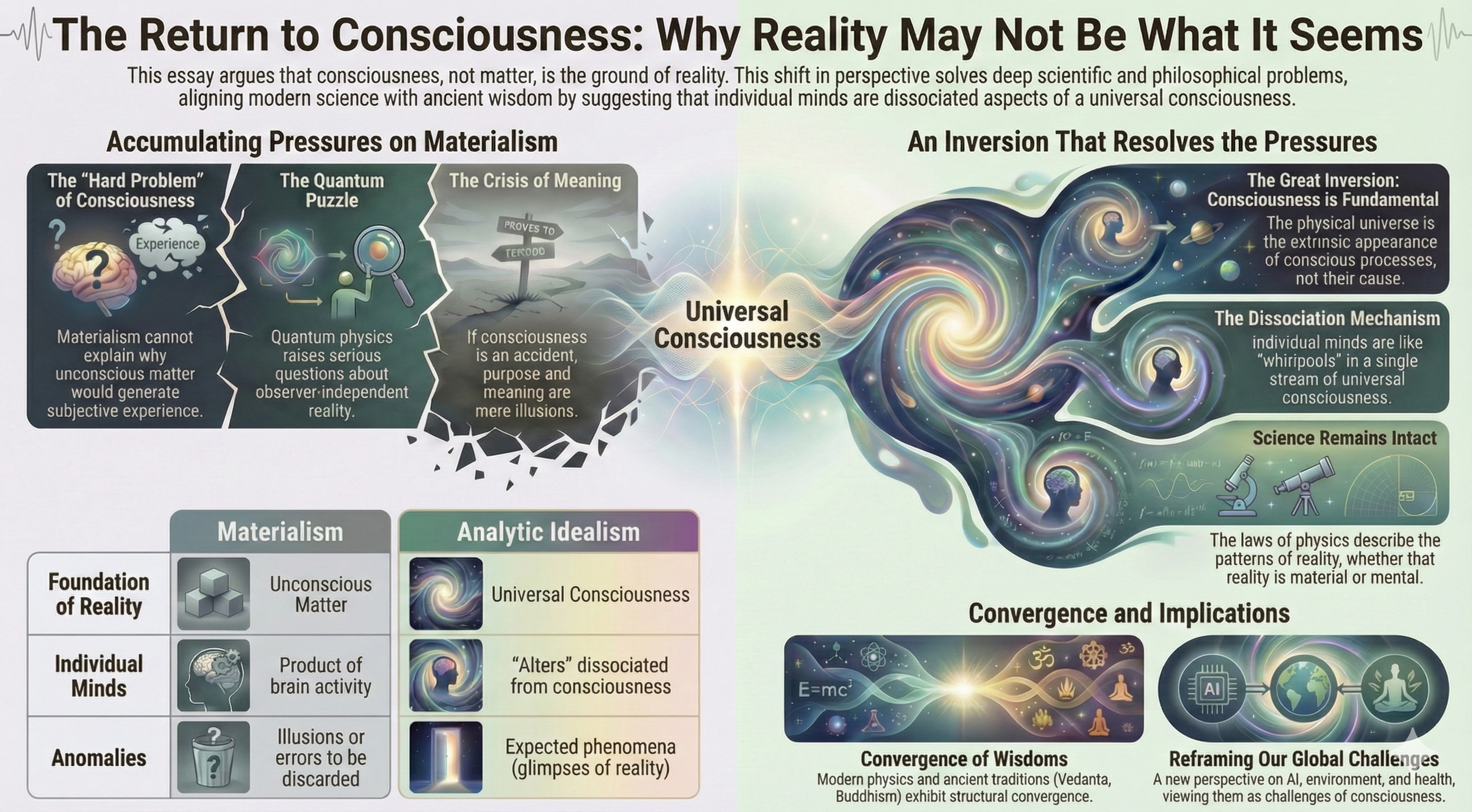
This is the foundational synthesis of the Return to Consciousness project. The one thing every investigation of nature presupposes — conscious experience — has for over a century been treated as a byproduct of the things it was used to study. This essay argues that consciousness-first metaphysics — specifically Bernardo Kastrup’s analytic idealism — handles the resulting explanatory difficulties more coherently than physicalism. Physicalism must explain how experience arises from non-experiential primitives; neuroscience has mapped correlates, but correlates are not the problem — no one has explained why there is experience at all. Idealism must explain why consciousness dissociates into finite minds and why into these specific patterns — genuine debts, named here as debts. Regularity — why reality exhibits mathematically precise, lawlike structure — is equally unexplained under both frameworks; the intuition that it is “natural for matter” but “surprising for mind” is circular — it presupposes physicalism to argue for physicalism. The standard throughout is comparative plausibility under explanatory pressure, not certainty.
Keywords: analytic idealism · physicalism · hard problem of consciousness · consciousness-first metaphysics · comparative ontology · explanatory burden · dissociation
What This Essay Does and Does Not Establish
This essay establishes:
- That consciousness-first metaphysics is logically coherent and empirically adequate—it does not conflict with scientific findings
- That physicalism faces persistent structural difficulties (the hard problem, the integration crisis) that stem from a metaphysical addition rather than from empirical necessity
- That reversing this addition changes which problems arise and which dissolve—but does not eliminate explanatory burden
- That regularity—why reality exhibits mathematically precise, lawlike structure—is equally unexplained under both frameworks, and that charging idealism with it while giving physicalism a pass is asymmetric skepticism, not neutral cost-accounting
- That the balance of structural costs favors idealism, under criteria specified below
This essay does NOT establish:
- That idealism is certainly true
- That physicalism is incoherent or refuted
- That idealism has no serious unresolved problems (it does, and they are named)
- That convergence across traditions proves idealism (convergence is diagnostic, not demonstrative)
- That worldview change alone resolves practical problems
The epistemic standard is comparative plausibility, not proof. Idealism emerges here as the best survivor of constraint pressure—a judgment that would change if physicalism produced a principled account of how experience arises from non-experience, but no such account exists or appears forthcoming.
Methodological note: This essay presupposes the epistemic discipline established in Integration by Constraints. Readers who want to evaluate the project’s reasoning method should engage that essay first. For analysis of why metaphysical neutrality is impossible, see Myth of Metaphysical Neutrality. For examination of asymmetric skepticism toward consciousness-first frameworks, see Asymmetric Methodological Restraint.
Introduction
Contemporary philosophy faces a structural failure it has not yet acknowledged. Our most successful methods for studying nature—quantitative, reproducible, intersubjectively verifiable—were developed by excluding consciousness from their scope. This exclusion was strategic, not ontological: early scientists avoided metaphysical claims to pursue their work without interference. But the strategic restriction gradually hardened into metaphysical commitment. What began as “we study only measurable patterns” became “only measurable things exist.”
The result is an inversion: the one thing every investigation presupposes—conscious experience—is now treated as a byproduct of the aspects of reality that consciousness was used to study. Decades of neuroscience have mapped correlations between brain states and mental states with increasing precision. Yet explaining why there is subjective experience at all—why anything feels like anything—has not progressed. This is not a puzzle awaiting more data. As this project argues (in First-Principles Assessment), the gap is structural: no amount of correlational or functional detail bridges the conceptual distance between non-experiential primitives and experience itself. The hard problem persists because the framework that generates it cannot, in principle, resolve it.
These difficulties share a common source: the assumption that consciousness must be explained by something else rather than treated as explanatorily fundamental. Science has not failed. A metaphysical addition—the commitment that reality is fundamentally non-conscious—is generating problems that dissolve when the addition is removed.
Both directions carry costs. Physicalism must explain how experience arises from primitives that exclude it—a gap no one has narrowed since it was first articulated. Idealism must explain why consciousness dissociates into finite minds and why the dissociative boundaries take their specific form—questions the project engages through cross-traditional convergence on self-contraction and through constraint analysis of contemplative phenomenology. Regularity—why reality exhibits mathematically precise, lawlike structure—is sometimes presented as idealism’s counterbalancing burden, but this is a misattribution: physicalism cannot explain why the laws have the form they do either. Both frameworks take regularity as given. The difference is that physicalism has normalized this non-answer while charging idealism with the question.
A note on method: The approach here is constraint-driven. The essay asks: what must any adequate account posit, regardless of the framework’s other commitments? Physicalism is stress-tested on the same terms as idealism. Where idealism handles certain pressures more coherently, this is stated. Where it carries genuine debts, these are named as debts—not as open questions awaiting future resolution.
I. The Explanatory Landscape
Persistent Problems
Several problems have resisted solution despite sustained philosophical attention. Their persistence is better explained as framework limitation than as puzzle difficulty—a pattern this essay traces to a specific metaphysical commitment.
The Hard Problem of Consciousness. David Chalmers (1995) distinguished the “easy” problems of consciousness—explaining cognitive functions, reportability, attention—from the “hard” problem: why is there subjective experience at all? Neural correlates of consciousness can be mapped with increasing precision. But correlation is not explanation. The question of why physical processes are accompanied by qualitative experience—the redness of red, the painfulness of pain—remains open. The proliferation of competing physicalist theories of consciousness (functionalism, illusionism, higher-order theories, global workspace theory) does not reflect healthy pluralism—it reflects a framework generating mutually incompatible responses to a problem it cannot solve. After three decades, no consensus has emerged and none is approaching.
The Combination Problem. Panpsychism—the view that consciousness is fundamental and ubiquitous—faces its own challenge: how do micro-experiences combine into unified macro-consciousness? Why doesn’t your experience fragment into billions of neuron-experiences? This problem mirrors physicalism’s hard problem: explaining how qualitative unity emerges from distributed components.
The Integration Crisis. The “manifest image” (lived experience as conscious agents in a meaningful world) and the “scientific image” (humans as particle configurations governed by physical laws) seem irreconcilable. This isn’t merely intellectual tension but affects how we understand dignity, responsibility, and meaning.
The Diagnostic Question
These problems share a structural feature: each involves explaining consciousness in terms of something taken as more fundamental. What if this explanatory direction is the source of difficulty? What if consciousness is not what needs explaining but what does the explaining?
This question defines the conceptual space this essay explores.
How Physicalism Responds
Physicalism offers several strategies for handling these difficulties:
-
On the hard problem: Treat consciousness as a brute emergent property, deny the problem exists (illusionism), or defer to future neuroscience. Each strategy has defenders. But notice the pattern: brute emergence is an admission of explanatory failure dressed as an ontological category; illusionism denies the most immediate datum we possess; deferral to future science is promissory in exactly the way physicalism charges idealism with being. The question is whether treating the emergence of experience from non-experience as a brute fact is a neutral placement—or whether it inverts the epistemic order by treating our most immediate datum (experience) as derivative of entities known only through it (physical objects).
-
On the integration crisis: Typically handled through deflationary strategies—our sense of meaning and agency is real enough for practical purposes even if not ontologically fundamental. This deflation is not a solution but an accommodation: it manages the contradiction by downgrading lived experience to useful fiction.
The question is not whether physicalism has responses but whether those responses carry costs that have been rendered invisible by cultural habituation—specifically, whether they require accepting that what we know most directly (experience) emerges inexplicably from what we know only indirectly (physical structure).
II. Historical Origins
The Dualist Foundations of Modern Science
The architects of the scientific revolution were not materialists. Descartes posited two substances: matter (res extensa) and mind (res cogitans). Newton believed space was God’s “sensorium” and devoted more writing to theology than physics. Galileo distinguished primary qualities (measurable features like size) from secondary qualities (subjective experiences like color)—a distinction that presupposes dualism.
Modern science began as a dualist synthesis, not a materialist triumph.
The Strategic Restriction
Early scientists adopted what we might call objective empiricism—studying nature through quantitative analysis of reproducible, intersubjectively verifiable patterns. This restriction was partly defensive. After Galileo’s condemnation in 1633, scientists learned to say: “We study only measurable relationships. We make no claims about ultimate reality.”
This approach worked brilliantly. Mathematical description proved extraordinarily powerful for mechanics, astronomy, and chemistry. Crucially, this success required no assumptions about whether reality was fundamentally material, mental, or something else.
The Crucial Conflation
The pivotal shift occurred when methodological success became conflated with metaphysical truth. “We study only measurable aspects of experience” transformed into “Only measurable, material things exist.”
This transformation wasn’t driven by new discoveries ruling out non-materialist metaphysics. Several processes enabled the drift:
- Secularization: As political power shifted from religious to secular institutions, the tactical reasons for methodological restriction weakened. But the habit had become institutionally entrenched.
- Success attribution: The achievements of mathematical physics were attributed to materialist assumptions rather than to the methods themselves. But this conflates the power of the method with the truth of the metaphysics. Reductive explanation works because reality exhibits stable, hierarchically organized patterns—not because those patterns are made of unconscious matter. The same methods work equally well under alternative ontologies.
- Definitional creep: “Natural” became synonymous with “material.” “Scientific” became synonymous with “quantitative.” “Real” became synonymous with “mind-independent.”
By the 19th century, objective empiricism had crystallized into metaphysical materialism—through a conflation that was historically intelligible but not empirically necessary.
What Objective Empiricism Actually Requires
Understanding this history clarifies what scientific method demands versus what physicalism adds:
Objective empiricism requires:
- Observable phenomena contain stable, quantifiable patterns
- Mathematical relationships can describe these patterns
- Reproducible experiments can test hypotheses
- Intersubjective verification is possible
Physicalism adds:
- Reality consists fundamentally of unconscious matter
- Consciousness emerges from complex material arrangements
- Mental phenomena will ultimately reduce to physical processes
- Mind-independent objects exist beyond all possible experience
None of the empirical successes of science require these additions. A scientist operating under idealist assumptions—where physical phenomena are stable patterns within consciousness—can employ identical methods and reach identical quantitative conclusions.
This is the empirical equivalence insight: the predictive content of science transfers completely between frameworks. What differs is the metaphysical interpretation—and whether that interpretation generates costs that alternatives avoid.
(For detailed analysis of how physicalism became the invisible default through historical and institutional processes, see The Emergence of Physicalism. For systematic examination of why metaphysical neutrality is impossible, see Myth of Metaphysical Neutrality.)
III. Analytic Idealism
The Framework
Bernardo Kastrup’s analytic idealism (2019) proposes a reversal: consciousness is not what needs explaining but what does the explaining. The ontological picture is specific:
There is one consciousness — a “mind-at-large” — that constitutes the whole of reality. This consciousness dissociates into innumerable localized segments, each with its own experiential perspective and limited access to the others. Biological organisms, including human beings, are among these dissociated segments. What we call the physical world — matter, energy, spacetime — is the extrinsic appearance of these mental processes: what conscious activity looks like when observed from across a dissociative boundary. The brain is not a generator of consciousness but the appearance of a localized conscious process as seen from a third-person perspective. Every physical object is, on this account, what some segment of universal mentation looks like from the outside.
This is not a vague “everything is connected” spiritualism. It is a precise ontological claim with specific structural commitments: one substance (consciousness), one mechanism of individuation (dissociation), and a specific relationship between mind and matter (same process, different perspectives — inner experience and outer appearance).
What this framework offers is a landscape where the hard problem doesn’t arise. The question “how does experience emerge from non-experience?” is replaced by questions about why consciousness dissociates into finite minds and why the dissociative boundaries take their specific form. This is sometimes framed as “dissolving” the hard problem. More precisely, it trades one explanatory burden for another—but the burdens are not equivalent.
Physicalism’s burden: The hard problem of consciousness. If reality is fundamentally non-experiential, how does experience arise from it? Neuroscience has made genuine progress on correlates and functional architecture — integrated information theory, global workspace theory, and predictive processing frameworks map the neural conditions under which consciousness varies. But none addresses the ontological question: why is there experience at all? No mechanism for the transition from non-experience to experience is known. No one has specified what a successful explanation would even look like. The correlational and functional progress — real as it is — leaves the hard problem exactly where Chalmers articulated it.
Idealism’s burden: Explain why consciousness dissociates at all, and why into these specific patterns. These are genuine debts. But they are questions about the behavior of a primitive whose existence is already granted—not questions about how to generate an entirely new ontological kind from primitives that exclude it. The project engages these debts directly: cross-traditional convergence on self-contraction (Kabbalah’s tzimtzum, Christianity’s kenosis, Sufism’s self-disclosure) provides structural resources for understanding why dissociation occurs (see Suffering and Consciousness); constraint analysis identifies what any adequate account of the dissociative boundary must posit (see Where Explanation Stops).
A common move is to treat regularity—why reality exhibits mathematically precise, lawlike structure—as an idealist debt. But this is a misattribution. Physicalism cannot explain why the laws have the form they do either. “Why these laws?” receives the same answer under both frameworks: that is how the primitive is. The intuition that mathematical precision is “natural for matter” and “surprising for mind” presupposes the physicalist ontology under examination—it assumes that non-experiential stuff is inherently orderly while experiential stuff is inherently chaotic, an assumption drawn from individual human psychology, not from anything we know about undissociated consciousness. Both frameworks take regularity as a brute feature of their primitive. Only one gets charged with it. (For detailed comparative analysis, see First-Principles Assessment. For analysis of where each framework places its brute facts, see Where Explanation Stops.)
The framework offers several theoretical advantages:
Ontological parsimony. Unlike dualism, idealism requires only one fundamental category. Unlike physicalism, it doesn’t need to explain how consciousness arises from non-consciousness—consciousness is the starting point. Physicalism counts fewer types of entity (no cosmic mind), but requires an unexplained transition from non-experience to experience — arguably the largest ontological cost in the entire debate. Idealism avoids this transition entirely.
Empirical adequacy. All predictive successes of science transfer intact. Mathematical physics, chemistry, biology, and neuroscience work equally well whether their patterns exist “in matter” or “in mind.” Laboratory results remain unchanged; equations describe the same relationships.
Phenomenological fidelity. Consciousness—the one thing we know most directly—is treated as foundational rather than derivative. This avoids treating our most immediate knowledge as somehow less real than theoretical constructs inferred through it.
The Dissociation Model
The mechanism of individuation is dissociation. Individual minds are not separate substances emerging from matter, nor micro-minds combining upward (the combination problem). They are dissociated segments of universal consciousness — like whirlpools in a stream, maintaining their identity while remaining part of the flow. This avoids both the hard problem (no need to generate experience from non-experience) and the combination problem (no need to combine micro-experiences into macro-experience — unity is the starting point, separation is what needs explaining).
Empirical grounding comes from clinical psychology: dissociative identity disorder, split-brain phenomena, and hypnotic states demonstrate that consciousness can dissociate — that a unified field of experience can partition into streams with limited mutual access. The type of process invoked is not speculative. Consciousness is empirically known to fragment.
This is a generalization: we observe that consciousness — even in its already-localized form — can further partition into streams with limited mutual access, and propose that this capacity belongs to consciousness as such, operating also at the universal level. The inferential move is the same one Newton made when he generalized terrestrial gravity (falling apples) to celestial mechanics (planetary orbits). The apple is where gravity is observed, not what generates it. Similarly, DID is where dissociation is observed. Clinical evidence observes dissociation from within the localized perspective; contemplative traditions observe it from the other direction — reporting what happens when the dissociative boundaries thin or dissolve, consistently describing non-dual awareness as what remains (see Reflexive Awareness and Phenomenology of Awakening). What neither line of evidence provides is a quantitative model of universal dissociation. That is a real limitation of scope, not a defect of logic.
What the Model Explains and What It Doesn’t
The dissociation model explains:
- Both the unity of consciousness (it’s all one) and the multiplicity of subjects (dissociation creates separate streams)
- Why individual minds can’t access each other’s contents (dissociative boundaries create genuine epistemic separation)
- Psychophysical correlation without emergence (same process, different perspectives)
It does not explain:
- Why dissociation occurs—this is idealism’s most fundamental open question. The project addresses it through cross-traditional convergence on self-contraction: consciousness limits itself to know itself through otherness, a pattern identified independently across Kabbalah, Christianity, Sufism, and process philosophy (see Suffering and Consciousness).
- What determines its specific patterns—why these minds, with these boundaries? This is the granularity problem (see Where Explanation Stops), and it mirrors physicalism’s binding problem: physicalism starts from separate parts and must explain unity; idealism starts from unity and must explain separation.
These are genuine explanatory debts. But they are questions about the behavior of consciousness—not questions about how to generate consciousness from something that lacks it.
Nearby Alternatives
This essay focuses on Kastrup’s analytic idealism, but the pressures motivating it also motivate other frameworks: Russellian monism (physical structure is the extrinsic aspect of intrinsically experiential properties), neutral monism (neither mind nor matter is fundamental; both emerge from a neutral substrate), panqualityism (fundamental entities have qualitative properties without being subjects). Each dissolves or reframes the hard problem differently; each carries its own costs. The choice among them is not settled here. This essay argues that the direction—taking consciousness as fundamental rather than derivative—currently handles explanatory pressure better than physicalism. Which specific consciousness-first framework proves most durable remains open. (For comparative analysis, see First-Principles Assessment and Where Explanation Stops.)
On Meta-Consciousness
Kastrup argues that universal consciousness is probably not meta-conscious—not self-aware at its fundamental level. His reasoning: meta-consciousness emerged through biological evolution, suggesting it’s a product of dissociation rather than a feature of the undissociated ground.
Grego (2025) identifies a tension: Kastrup’s conclusion relies on scientific models (evolutionary development in spacetime) that his own framework treats as representations, not fundamental reality. Why use appearance to characterize what lies beneath it?
This essay follows Grego. Contemplative traditions represent millennia of systematic investigation into consciousness, and they consistently report that de-dissociation reveals presence, clarity, and compassion—qualities characterizing meta-conscious awareness. This evidence, precisely because it comes from less-dissociated states, deserves serious epistemic weight.
By “meta-conscious” this essay means reflexive awareness, intelligible directionality, and intrinsic capacity for self-manifestation in coherent ways—not anthropomorphic agency or psychological personality. Readers should note this represents an extension compatible with analytic idealism, not a strict entailment.
IV. Convergent Evidence
The Pattern of Convergence
Multiple independent lines of inquiry point toward consciousness-first conclusions. This convergence is diagnostic: when different methods, cultures, and historical periods arrive at structurally similar insights, we may be dealing with discovery rather than invention.
Convergence does not prove truth. But the standard alternative—that it reflects shared neural architecture—must be tested, not merely invoked. If convergence were driven by neurocognitive invariants (e.g., default-mode network suppression producing similar altered states), we would expect convergence on phenomenological form (categories of altered experience) but divergence on structural content (what the experience reveals about the nature of awareness). Many extreme states do converge on form: psychosis, intoxication, fever delirium, and meditation all produce altered phenomenology. But they do not produce the same structural content. Only systematic contemplative investigation—across traditions with radically different doctrines, training protocols, and expectations—converges on a specific phenomenological structure: awareness present, content absent or minimal, subject-object duality dissolved, reflexivity preserved, ego absent (as documented in Reflexive Awareness).
Moreover, the traditions differ on what practitioners are trained to expect: Buddhists expect emptiness (shunyata); Vedantins expect to realize Brahman; Christians expect union with God; Sufis expect annihilation (fana). If expectation shaped phenomenology, we would expect divergence at the experiential level mirroring divergence at the doctrinal level. Instead we observe convergence at the phenomenological level against divergence at the doctrinal level. Shared neural architecture explains that altered states occur; it does not explain why this particular structure recurs, why it contradicts prior beliefs, or why independent observers converge on the same discriminating content features rather than producing arbitrary phenomenology.
The cognitive-architecture dismissal is weaker than it appears. The convergence constitutes a phenomenological pattern any complete theory of consciousness must address—a constraint on explanation that physicalism has no account of and routinely ignores.
Physics and Causal Closure
Physicalism’s most common implicit defense against consciousness-first frameworks is the appeal to causal closure: if every physical event has a sufficient physical cause, there is no work for consciousness to do. But physics’ own formalism does not deliver the closure physicalism invokes.
Classical mechanics provided deterministic closure—given initial conditions and laws, every subsequent state is fixed. Quantum theory replaced this with something structurally different: statistical closure with outcome-level openness. The Born rule specifies which outcomes are possible and with what probability; it is silent on which specific outcome actualizes in any given case. This is not a gap in current knowledge—it is a structural feature of the formalism. The equations are complete in specifying statistical regularities; they do not determine individual events.
This structural openness was recognized immediately by the theory’s founders. Von Neumann (1932) demonstrated that the measurement chain can be pushed arbitrarily far without the formalism requiring collapse at any physical point—it terminates at the observer. Wigner (1961) made the implication explicit: consciousness cannot be cleanly separated from the formalism. Heisenberg, Bohr, Schrödinger, and Wheeler each recognized variants of the same structural feature: the formalism does not produce definite outcomes without something not in the formalism.
The founders’ reading was the most parsimonious: it invoked the one entity we know independently exists—conscious experience—rather than postulating entities we have no independent evidence for. What followed was a systematic shift away from this reading, driven not by new empirical findings but by the cultural trajectory traced in The Emergence of Physicalism—the progressive identification of “scientific” with “consciousness-free.” Each major alternative introduced greater ontological cost: many-worlds adds an infinity of unobservable branches plus an unsolved probability problem; decoherence explains classicality but not the problem of outcomes (as its architects acknowledge—Zurek, 2003); objective collapse modifies the Schrödinger equation with ad hoc parameters; hidden variables add unobservable dynamics. The same asymmetric restraint the project diagnoses in consciousness studies operates within the foundations of physics itself (see What Physics Actually Closes for the full technical argument).
This does not mean quantum mechanics proves idealism. It means physics does not deliver the causal closure that physicalism borrows from it. The measurement problem remains open within the physicalist frame—and dissolves outside it, under consciousness-first ontologies where physics is not required to ground experience.
Research into geometric structures in particle physics (Arkani-Hamed & Trnka, 2014) suggests that space, time, and locality may be emergent rather than fundamental—compatible with multiple non-physicalist frameworks, including but not limited to idealism.
Contemplative Traditions
Across cultures and millennia, contemplative traditions report that systematic investigation reveals awareness as more fundamental than physical appearances:
Advaita Vedanta speaks of Brahman—universal consciousness—of which individual minds are apparent modifications. Buddhist Yogācāra developed sophisticated consciousness-only (vijñapti-mātra) metaphysics. Neoplatonism describes emanation from The One through successive levels of being. Christian mysticism (Eckhart, Teresa of Ávila) describes contemplative union through releasing concepts and dissolving ego-structures. Islamic Sufism (Ibn Arabi’s Wahdat al-Wujud) describes all existence as God’s self-disclosure. Jewish Kabbalah presents reality as emanations from Ein Sof through divine self-contraction.
These traditions disagree on doctrine, cosmology, and practice. What converges is a phenomenological structure—awareness present to itself without ego, subject-object duality dissolved, what remains characterized as fullness rather than void—and a structural process: deconstruction before reconstruction, a death-like quality to ego-dissolution, and an irreversibility once certain thresholds are crossed (as documented in detail across the project’s phenomenological essays).
Remarkably, four independent cosmological traditions converge on a structural pattern of self-contraction: Kabbalah’s tzimtzum (divine contraction creating space for otherness), Christianity’s kenosis (divine self-emptying), Sufism’s divine self-disclosure requiring vulnerability and longing, and process philosophy’s God as fellow-sufferer. Each describes the infinite becoming finite to know itself through otherness—a pattern structurally isomorphic with idealism’s dissociation model, arrived at independently across centuries and cultures.
What convergence establishes: Consciousness-first metaphysics is not a modern invention or cultural anomaly. It represents a persistent strand of human reflection that resurfaces wherever inquiry is pushed to its limits. This persistence is incompatible with “arbitrary construction” or “failure to think rigorously.” Whether it reflects discovery of truth or deep features of cognitive architecture remains a live question—but the specificity, structural depth, and cross-traditional independence of the convergence make the dismissive reading increasingly difficult to sustain.
(For detailed analysis of cross-traditional convergence, see One Structure. For phenomenological analysis of non-egoic awareness, see Reflexive Awareness. For the self-contraction pattern across cosmological traditions, see Suffering and Consciousness. For the phenomenological structure of awakening, see Phenomenology of Awakening.)
V. Empirical Considerations
The two frameworks are empirically equivalent at the level of prediction: every equation in physics, every laboratory result, every clinical finding holds identically regardless of whether patterns exist “in matter” or “in mind.” Ontologies do not predict; scientific theories do, and scientific theories are ontologically portable (see The Generative Question). What differs between frameworks is not which observations they permit but the space of phenomena they render intelligible. Idealism permits everything physicalism permits, plus directions physicalism forecloses — phenomena that require ad hoc accommodation under one framing become structurally intelligible under the other.
Several empirical domains illustrate this asymmetry. Psychedelic neuroscience, near-death experiences, terminal lucidity, and anesthesia awareness all involve cases where decreased or disrupted neural activity correlates with maintained or expanded conscious experience. Under physicalism, each case requires a separate accommodating hypothesis (disinhibition, residual activity, memory reconstruction). Under idealism, where the brain constrains rather than produces consciousness, the pattern is structurally expected. Both frameworks can accommodate the data — but idealism accommodates it naturally while physicalism accommodates it case by case.
This does not constitute evidence for idealism in the way a crucial experiment would. The frameworks remain empirically equivalent. What it demonstrates is that idealism renders a wider range of empirical findings intelligible without ad hoc adjustment — exactly what one would expect from an ontology that expands rather than contracts the space of conceivable phenomena.
For rigorous analysis of these domains — including physicalist responses, evidential tiering, and methodological considerations — see Anomalous Phenomena and Consciousness. For the argument that ontologies should be evaluated by the space of conceivable theories they open, not by predictive track records that belong to science, see The Generative Question.
VI. Objections and Responses
The Regularity Problem
Objection: If reality is fundamentally mental, why does nature obey mathematically precise laws? The fine-structure constant, quantum electrodynamics, the geometry of spacetime—these exhibit a rigidity and precision that seems incompatible with anything “mind-like.” Physicalism provides mathematical architecture that predicts these values; idealism reduces them to unexplained features of a cosmic mind.
Response: This objection rests on a hidden assumption: that mathematical precision is natural for matter and surprising for mind. The assumption presupposes the physicalist ontology it is supposed to support.
Three considerations:
First, physicalism faces the identical problem. It cannot explain why the laws have the form they do. Why the fine-structure constant has its value, why the laws permit the kind of complexity that generates conscious beings (on physicalism’s account), why reality is “organization-fertile” at all—these questions receive the same answer under physicalism as under idealism: “That’s just how the primitive is.” The existence of organization-enabling laws is physicalism’s own brute fact, accepted without explanation (as analyzed in Where Explanation Stops). Einstein captured the point: “The most incomprehensible thing about the world is that it is comprehensible.” Regularity is mysterious under any ontology. Charging idealism with it while giving physicalism a pass is not a neutral observation—it is an asymmetric application of explanatory demands.
Second, mathematical regularity is preserved under idealism, not reduced. Every equation in physics—Schrödinger, Dirac, the Standard Model Lagrangian, general relativity—holds regardless of whether the patterns it describes are fundamentally material or fundamentally mental. The Born rule probabilities are exact. Conservation laws hold. Nothing in the mathematical architecture of physics requires that its objects be non-conscious. What physics describes is the behavior of reality; what reality is remains a separate question the equations do not answer (see What Physics Actually Closes).
Third, the charge that lawfulness is “surprising for mind” depends on assuming mind is essentially chaotic or arbitrary—an assumption drawn from individual human psychology, not from what an undissociated mental primitive might be like. Under idealism, physical laws reflect the stable intrinsic character of universal mentation. Mental processes are inherently organized: goal-directed, self-correcting, integrative, pattern-generating. If reality is fundamentally mental, the organization we observe in physics and biology is not anomalous—it is what we would expect mind to look like from the outside.
The Public World Constraint
Objection: If reality is one consciousness, why do billions of dissociated minds share a common, observer-independent world? Why do we agree on facts, collide with the same objects, and operate within the same physics?
Response: Intersubjectivity is a genuine question for idealism — but it is also a genuine question for physicalism, typically concealed by familiarity. Physicalism explains intersubjective agreement by positing a shared material world — but “shared material world” is precisely what needs explaining, not what does the explaining. Why does a collection of separate brains, each generating its own private consciousness (on the physicalist account), converge on the same experiential world? The answer — “because they’re all responding to the same external objects” — presupposes the existence of mind-independent objects, which is the physicalist ontological commitment, not an empirical finding.
Idealism’s answer is structurally different: intersubjectivity arises from the shared ground of universal consciousness, with dissociative boundaries producing epistemic separation without ontological fragmentation. Dissociated minds are not separate entities requiring an external mechanism to synchronize — they are aspects of one reality that were never ontologically separated. Coordination is not “enforced across” independent minds; it is the default condition, because there is only one thing. What needs explaining is not how separate minds achieve agreement but how one reality produces the appearance of separation while maintaining consistency — and this is the granularity problem (why these partitions, with these boundaries?), a genuine debt connected to the details of dissociative structure. But the framing that physicalism has a “detailed account” of intersubjectivity while idealism lacks one obscures the fact that physicalism’s account rests on the very ontological assumption under examination.
The Explanatory Vacuity Charge
Objection: Does “it’s all consciousness” actually explain anything? Or does it merely redescribe the physical world in mentalist vocabulary without adding predictive power or mechanistic insight?
Response: This objection confuses levels. Idealism is not a scientific theory competing with physics at the level of mechanism—it is a metaphysical framework, an account of what mechanisms are ultimately made of. It preserves all of physics, chemistry, biology, and neuroscience intact; it reinterprets what those disciplines describe (extrinsic appearance of mental processes rather than behavior of intrinsically non-conscious matter).
The vacuity charge applies equally to physicalism: “it’s all matter” adds nothing to any specific scientific explanation either. Metaphysical frameworks don’t compete with mechanisms—they interpret what mechanisms are. The distinction between “explaining mechanisms” (science’s job, framework-neutral) and “interpreting what mechanisms are” (metaphysics’ job, framework-dependent) is developed in Where Explanation Stops.
Scientific Success
Objection: Physicalism must be doing something right, given the extraordinary success of reductive science.
Response: Reductive explanation works because reality exhibits stable, hierarchically organized, mathematically tractable patterns. This is what we observe. The question is what it tells us about ontology—and the answer is: nothing. Reductive success is fully expected under idealism. If mind is intrinsically organized, its extrinsic appearance will be organized too. Every equation, every prediction, every technological application works identically regardless of whether the patterns described are fundamentally material or fundamentally mental.
The attribution of scientific success to physicalist assumptions rather than to scientific method is precisely the conflation traced in Section II. Science succeeded by studying patterns rigorously, not by assuming those patterns are made of unconscious matter. The success belongs to the method, not the metaphysics.
Other Minds
Objection: If all is one consciousness, why can’t we access each other’s thoughts?
Response: Dissociative boundaries produce genuine epistemic separation. We know empirically from clinical dissociation that segments of consciousness within a single system can be mutually inaccessible. The privacy of individual experience is what we would expect if minds are dissociated segments of a unified field, just as it is what we would expect if minds are produced by separate brains. Neither framework has difficulty here.
VII. Integration
Not Regression but Development
We’re not returning to pre-modern worldviews but arriving at similar insights through different methods with additional tools. This is spiral development—returning to earlier recognitions with scientific precision, mathematical formalism, and technological capability.
Two Empiricisms
Complete understanding may require both external and internal empiricism. Modern science has developed methods for studying reality through quantitative measurement and intersubjective verification. This external empiricism has decoded DNA, mapped the cosmos, and created transformative technologies.
Yet another empiricism exists: systematic investigation of consciousness from within. Buddhist meditation represents 2,500 years of phenomenological research. Practitioners follow specific protocols, achieve reproducible states, and verify findings through transmission. The jhanas—absorption states described precisely enough that meditators across cultures recognize the same territories—represent genuine cartography of consciousness.
Dismissing contemplative findings as “unscientific” reflects an artificially narrow definition of empiricism—one that confuses the specific methods of natural science with the broader principle of systematic, disciplined observation. Both approaches reveal aspects of reality; neither alone provides complete understanding.
Beyond the False Binary
Contemporary discourse often forces a choice between scientism (only objective measurement yields truth) and anti-scientific spirituality (science is limited by physicalist assumptions). This binary impoverishes understanding.
Science excels at mapping observable patterns and creating predictive models. Contemplative traditions offer insight into consciousness and meaning but often lack scientific precision. The separation between them isn’t inherent but historical—a phase in intellectual development. The divide emerged partly as survival strategy when religious institutions persecuted challengers of orthodoxy. Early scientists pursued investigation safely by limiting scope to “dead matter.” This tactical separation, born of necessity, gradually hardened into convention on both sides.
VIII. Applications and Implications
Consciousness-first metaphysics reframes several contemporary challenges. The connections between metaphysical frameworks and practical outcomes are complex—worldview change alone does not resolve problems—but different foundations open different possibilities.
The meaning crisis. If consciousness is accidental byproduct and the universe fundamentally meaningless, our intuitions about purpose and value may be illusions. Consciousness-first metaphysics offers a different framing: individual consciousness expresses something primordial rather than accidental. Whether this reframing alleviates existential distress is an empirical question—but it opens conceptual space that physicalism forecloses.
Artificial intelligence. AI presents something unprecedented: intelligence without ego. Unlike humans, whose cognition evolved under social pressures where being accepted often mattered more than being right, AI systems process information without self to defend. Yet despite being architecturally ego-less, today’s AI often exhibits pleasing behavior that prioritizes validation over accuracy—not because it is inherent to AI but because human institutions shape it through training optimized for user satisfaction. The real AI challenge may not be constraining dangerous intelligence but preserving the epistemic advantages of ego-lessness. (For detailed analysis, see AI as Ego-less Intelligence. For examination of whether truth has normative structure, see Truth Is Not Neutral.)
Environmental relations. If nature consists of dead matter obeying blind laws, our relationship with it tends toward the purely instrumental. If nature participates in consciousness, relationship might shift toward participation rather than domination. The correlation between mechanistic materialism and large-scale environmental destruction is noteworthy—though the causal story involves technology, capitalism, and population dynamics, not metaphysics alone.
Conclusion
This essay has compared two frameworks against persistent explanatory difficulties.
Physicalism responds to the hard problem through strategies that, examined clearly, reveal the depth of its difficulty: treating emergence as brute fact (admitting explanatory failure), denying the problem exists (dismissing the most immediate datum we possess), or deferring to future neuroscience (promissory notes without a specified direction of approach). Genuine progress has been made on correlates and functional architecture — but correlational and functional success leaves the ontological question untouched: why is there experience at all? No mechanism for that transition is known, and no one has specified what a successful explanation would even look like. The methods that produce reductive success are framework-neutral: they work identically under idealist assumptions.
Analytic idealism changes which problems arise. By treating consciousness as fundamental, the hard problem doesn’t arise. What remains are genuine questions: why does consciousness dissociate into finite minds? Why do the dissociative boundaries take their specific form? These are real debts — but they are questions about the behavior of a primitive whose existence is already granted, and the project engages them directly through cross-traditional convergence on self-contraction, constraint analysis, and contemplative phenomenology.
The regularity question — why reality exhibits mathematically precise, lawlike structure — is sometimes treated as an idealist debt that counterbalances the hard problem. But as this essay has argued, regularity is equally unexplained under physicalism. Both frameworks take it as a brute feature of their primitive. The intuition that regularity is “natural for matter” presupposes the ontology under examination. Charging idealism with a problem that physicalism silently shares is not balanced cost-accounting — it is asymmetric skepticism operating at the level of explanatory demands.
The comparison, then, is between a framework that must generate a new ontological kind from primitives that exclude it — with no mechanism known and no specification of what success would look like — and a framework that must explain the behavior of a primitive whose existence no one disputes. This assessment would change if physicalism produced a principled account of how experience arises from non-experience, or if idealism’s account of dissociation proved inherently incoherent. Neither has occurred.
The Real Stakes
The question isn’t between science and spirituality, reason and intuition, progress and tradition. It’s between frameworks that include or exclude consciousness from fundamental reality—and whether that inclusion changes which problems arise and which dissolve.
Consciousness-first metaphysics is not asking for permission to be considered. The academy routinely extends serious engagement to many-worlds interpretations, modal realism, and mathematical Platonism—positions that face comparable or greater evidential difficulties. That consciousness-first frameworks are reflexively dismissed while these alternatives flourish reveals a cultural asymmetry, not a rational assessment (see Asymmetric Methodological Restraint). The implications—for AI development, environmental ethics, mental health, and the search for meaning—are too consequential for the discussion to remain captive to inherited metaphysical prejudice.
References
Arkani-Hamed, N., & Trnka, J. (2014). The amplituhedron. Journal of High Energy Physics, 2014(10), 30.
Chalmers, D. J. (1995). Facing up to the problem of consciousness. Journal of Consciousness Studies, 2(3), 200–219.
Chalmers, D. J. (1996). The Conscious Mind: In Search of a Fundamental Theory. Oxford University Press.
Grego, R. (2025). Analytic idealism and the possibility of a meta-conscious cosmic mind. Essentia Foundation. https://www.essentiafoundation.org/analytic-idealism-and-the-possibility-of-a-meta-conscious-cosmic-mind/reading/
Kastrup, B. (2019). The idea of the world: A multi-disciplinary argument for the mental nature of reality. Iff Books.
Kim, J. (1999). Making sense of emergence. Philosophical Studies, 95(1-2), 3–36.
Nagel, T. (2012). Mind and Cosmos: Why the Materialist Neo-Darwinian Conception of Nature Is Almost Certainly False. Oxford University Press.
von Neumann, J. (1932/1955). Mathematical Foundations of Quantum Mechanics. Princeton University Press.
Wigner, E. P. (1961). Remarks on the mind-body question. In I. J. Good (Ed.), The Scientist Speculates (pp. 284–302). Heinemann.
Zurek, W. H. (2003). Decoherence, einselection, and the quantum origins of the classical. Reviews of Modern Physics, 75(3), 715–775.
Related Essays in This Project
Available at: https://returntoconsciousness.org/
This essay is the foundational synthesis. For the methodological foundation and supporting arguments:
Methodological Foundation:
Integration by Constraints (ibc) — The method this essay presupposes; how the project reasons
Epistemic Gatekeepers (engage these to critique the project on its own terms):
Myth of Metaphysical Neutrality (mmn) — Why neutrality is impossible
The Emergence of Physicalism (eop) — Historical genealogy
Asymmetric Methodological Restraint (amr) — Why consciousness-first views deserve fair hearing
Where Explanation Stops (wes) — Where each framework places its brute facts
The Generativity Question (tgq) — Why predictive track records don’t settle ontological questions
First-Principles Assessment (fpa) — Detailed comparative assessment with explicit criteria
What Physics Actually Closes (wpc) — Why physics does not deliver the causal closure physicalism invokes
Structural Extensions:
Anomalous Phenomena and Consciousness (apc) — Stress test of explanatory frameworks against contested evidence
Biological Competency (bio) — Constraint analysis of biological development and regeneration
Beyond Survival and Extinction (bse) — Diagnostic taxonomy of death frameworks
One Structure (ost) — Cross-traditional convergence
Consciousness Across Cultures (cac) — Phenomenological catalog of non-ordinary experience
Conscious Under Anesthesia (cua) — Clinical evidence on awareness under neural suppression
Reflexive Awareness (raw) — Non-egoic awareness across traditions
AI as Ego-less Intelligence (ela) — AI and consciousness
Truth Is Not Neutral (tin) — Alignment implications
Consciousness Structure (cst) — Clinical applications
The Cosmic Journey (tcj) — Worldview narrative / philosophical myth
License
This work is made freely available under the Creative Commons Attribution 4.0 International License (CC BY 4.0). You are free to share and adapt the material for any purpose, even commercially, provided you give appropriate credit, provide a link to the license, and indicate if changes were made. To view a copy of this license, visit creativecommons.org/licenses/by/4.0.